

Persistent skin lesions in parrots are not always just infections or dermatitis; some cases may involve underlying malignant tumors.
Skin and feather problems are common reasons for parrots to seek medical attention. Clinically, owners easily notice signs such as localized feather loss, scabbing, recurrent weeping of wounds, skin ulcers, abnormal growths, or localized lumps. However, these surface changes may not represent simple dermatitis or bacterial infection; they can also be related to chronic irritation, nutritional imbalances, self-trauma, or even neoplastic (tumorous) lesions.
Case Progress and Clinical Situation
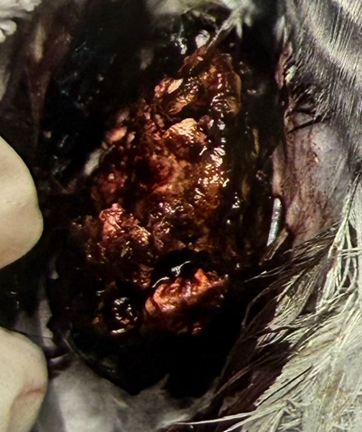
This case involves an African Grey Parrot with a chronic lesion on the skin of the inner right wing. The area was locally infected and growing rapidly. Pathological examination confirmed the lesion as cutaneous squamous cell carcinoma (SCC), accompanied by ulceration and a secondary mixed bacterial infection. Due to the continuous deterioration of the lesion, surgical excision under general anesthesia was ultimately required.
Because the lesion was located near vital tissues of the wing and the availability of normal skin for suturing was limited, the surgery itself presented a certain degree of difficulty. Clinically, if similar lesions are not addressed early, the tumor will continue to expand, often requiring more extensive excision. In severe cases, wing amputation may even be necessary, which significantly impacts the bird’s function and quality of life.

Parrots Also Get Cancer; Early Intervention Reduces Surgical Scope
Many owners interpret skin lesions in parrots as general trauma, infection, or dermatitis, but the fact is that parrots can also suffer from cancer. Cutaneous squamous cell carcinoma is a malignant skin tumor seen in birds, characterized by strong local invasiveness and the continuous destruction of surrounding skin and soft tissue.
Squamous cell carcinoma in birds is typically locally invasive, with distant metastasis being relatively less common; however, this does not mean treatment can be delayed. When a lesion persists and expands, it not only worsens local ulceration, infection, and pain but also increases the required surgical margin. This may lead to more traumatic procedures, such as wide excision or amputation. Furthermore, the risk of tumor spread, including distant metastasis to the lungs, cannot be entirely ignored.
Therefore, for skin lesions in parrots that are non-healing, recurrently infected, rapidly enlarging, or persistently ulcerated, early examination and treatment are vital. Intervening at an earlier stage often provides a better chance of completing the procedure while preserving more normal tissue, thereby reducing trauma and follow-up risks.
Skin Disease, Nutrition, and Vitamin Issues Cannot Be Ignored
Abnormalities in a parrot’s skin and feather condition are often not caused by a single factor. In addition to tumors, chronic infections, feather-destructive behavior, environmental irritants, hygiene issues, and nutritional imbalances can all cause ongoing damage to skin and feather health.
Clinically, if a parrot is fed a diet consisting solely of seeds or is a picky eater, they are prone to nutritional deficiencies, with Vitamin A deficiency being particularly noteworthy. Vitamin A is crucial for epithelial health, immune function, and the maintenance of mucous membranes. When nutrition is chronically imbalanced, the condition of the skin and membranes deteriorates, local resistance drops, and the bird becomes more susceptible to recurrent infections, abnormal keratinization, and chronic skin issues.
While nutritional imbalance does not directly cause tumors, a state where the skin is chronically inflamed, damaged, or poorly repaired may make existing lesions harder to heal or delay the discovery of the true underlying cause. Therefore, when facing skin abnormalities in parrots, besides treating the surface wound, one should also evaluate:
- Whether the daily diet is balanced.
- The presence of Vitamin A or micronutrient deficiencies.
- Whether there is recurrent infection or chronic irritation.
- Whether further testing is needed to rule out neoplastic lesions.
Why Regular Check-ups Are Essential
Parrots are masters at masking discomfort, and many pathological changes may not cause obvious systemic symptoms in the early stages. Some owners only realize the severity of the problem once the lesion has ulcerated, bled, become infected, or enlarged rapidly.
This case reflects how a lesion that looks like simple skin inflammation or a chronic wound can be confirmed as a malignant tumor through pathology. For middle-aged to senior parrots, or individuals with a history of skin abnormalities, chronic wounds, feather issues, localized lumps, loss of appetite, or weight changes, regular physical exams can help detect abnormalities early. This allows for appropriate treatment while the lesion is still localized, reducing the risk of extensive surgery and complications.
Treatment Significance and Follow-up Monitoring
Regarding avian cutaneous squamous cell carcinoma, if the location and scope of the lesion allow, surgical excision is usually the most important treatment method. In contrast, non-surgical treatments for cases that cannot be completely excised or are unsuitable for surgery often yield unsatisfactory results.
Although this patient has undergone surgery, close follow-up monitoring is still required, including:
- Wound healing progress.
- Checking for any local regrowth, ulceration, or discharge.
- Signs of recurrence on the wing skin.
- Overall changes in spirit, appetite, and weight.
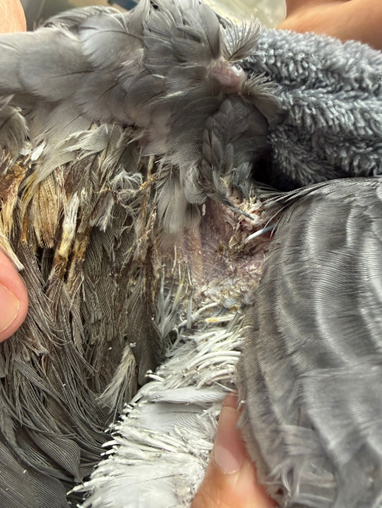
Fortunately, the wound in this case is currently recovering well, and healing is progressing ideally. Follow-up appointments will continue to be scheduled as clinically necessary to assess local control and overall health.
Image Captions
Figure 1 | Appearance of the skin lesion on the inner right wing during the initial consultation; localized feather soiling, skin damage, and chronic inflammatory changes are visible.
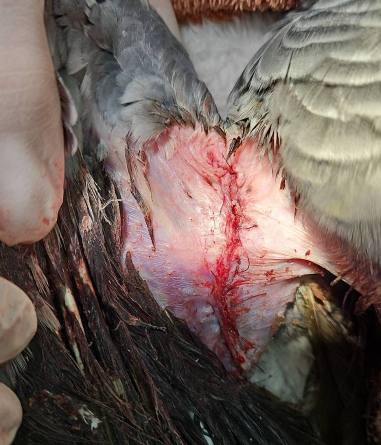
Figure 2 | Close-up of the wound after surgery.
Figure 3 | Current healing progress is ideal.
Summary
If a parrot exhibits a persistent non-healing wound, localized lump, ulceration, recurrent infection, bleeding, or abnormal feather loss, it is recommended to seek a veterinary examination as soon as possible. Early detection, diagnosis, and treatment are crucial for reducing trauma, improving treatment outcomes, and bettering the prognosis.
Cityvet Parrot Clinic
Cityvet is dedicated to providing excellent, comprehensive veterinary medical services. Upholding the core values of “Professionalism, Care, and Trust,” we aim to provide affordable care, utilize advanced equipment, and offer detailed explanations of treatment options to provide comprehensive medical care for every pet.
Want to book a parrot consultation? Please call our Tsuen Wan branch at 2623 5500 or our Yuen Long branch at 2477 9990. Address: G/F, 186 Sha Tsui Road, Tsuen Wan / Shop 2, G/F, Fortune Sunshine House, 25 Ping Wui Street, Yuen Long.
Disclaimer: This article provides general information only and cannot replace professional medical diagnosis. If you have any concerns, please book a veterinary check-up as soon as possible.