Why Is It Important to Organize Information Before the First Visit?
Sheep and cattle are both ruminants, and many problems involve more than a single organ system. Feed, environment, parasite control, hoof care, and herd conditions may all be involved at the same time. The more complete the information an owner prepares before the first visit, the easier it is for the veterinarian to identify the likely direction quickly and reduce unnecessary trial and error. Medical history, diet, housing conditions, and herd status are all important foundations for building a treatment plan.
Six Essential Types of Information to Prepare Before the Visit
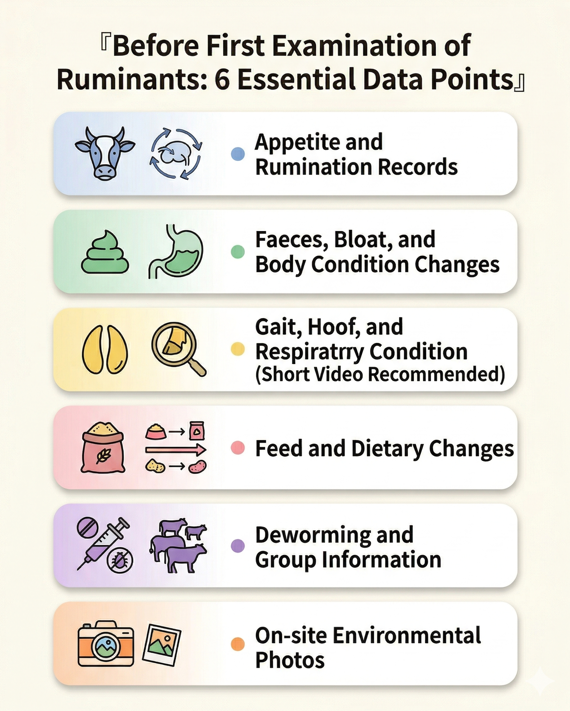
1. Appetite and rumination records
Please prepare records of appetite and rumination, such as whether there has been reduced appetite, selective eating, fewer rumination episodes, or complete cessation over the past few days.
2. Feces, abdominal bloating, and body condition changes
Has there been abdominal distension, kicking at the belly, diarrhea, bloody stool, foul-smelling feces, obvious recent weight loss, or poorer coat condition? These are all common assessment points in ruminants.
3. Gait, hoof condition, and breathing status
If there is lameness, difficulty standing, hoof swelling or heat, coughing, nasal discharge, or rapid breathing, short videos are very helpful. For veterinarians, moving images often make it easier to judge the likely cause.
4. Feed and dietary changes
This includes any recent change in hay, feed, treats, feeding schedule, or shared feeding with other animals. Many digestive problems in ruminants are closely related to dietary change.
5. Deworming history and herd information
Has regular deworming been carried out? Are other animals in the same group showing similar signs? This information is very helpful when considering parasites and infectious disease.
6. Photos of the site environment
It is helpful to take photos showing whether the floor is damp, the ventilation, resting area, feeding area, and the surfaces in contact with the hooves.
Transport and Pre-Visit Precautions
If the animal needs to come to the clinic, transport stress should be minimized as much as possible. Call the clinic in advance to explain the animal’s size, symptoms, whether it can stand, and whether there is any breathing difficulty. If the animal is down, in obvious pain, has worsening bloat, or has abnormal signs after giving birth, contact the hotline first so the clinic can help advise on the most appropriate arrangement.
What Usually Happens After Arrival at the Clinic
The process generally begins with history-taking and environmental assessment, followed by a physical examination and, when appropriate, fecal or blood testing. Digital X-rays, ultrasound, or other imaging may also be arranged as needed. Hospitalization for observation may sometimes be recommended. These steps help owners receive a more complete veterinary diagnosis and treatment plan within one coordinated medical process.
FAQ
Q1: What is the single most important thing to bring before a first visit for a sheep or cow?
A: The most important things are a clear medical history and information on diet, elimination, activity level, herd situation, and environment.
Q2: Should ruminants be fasted before a veterinary visit?
A: Do not change the diet or start fasting on your own. Call the clinic first for case-specific advice.
Q3: Is a photo enough for lameness?
A: A short video is better, because the gait in motion often provides more useful diagnostic information.
Q4: If the rest of the herd seems fine, does that mean it is not infectious?
A: Not necessarily. The individual history, environment, and test results still need to be assessed together.
CityVet Ruminant Consultation
CityVet is committed to providing outstanding, comprehensive veterinary care. Guided by our core values of professionalism, compassion, and trust, we aim to offer reasonably priced services, advanced equipment, and clear explanations of all treatment options, so every pet receives complete medical support.
To book a ruminant consultation, please call our Tsuen Wan branch at 2623 5500 or our Yuen Long branch at 2477 9990. Address: G/F, 186 Sha Tsui Road, Tsuen Wan / Shop 2, G/F, Fuk Shun Building, 25 Ping Wui Street, Yuen Long.
Disclaimer: This article is for general information only and does not replace professional medical diagnosis. If you have concerns, please arrange a veterinary examination as soon as possible.