

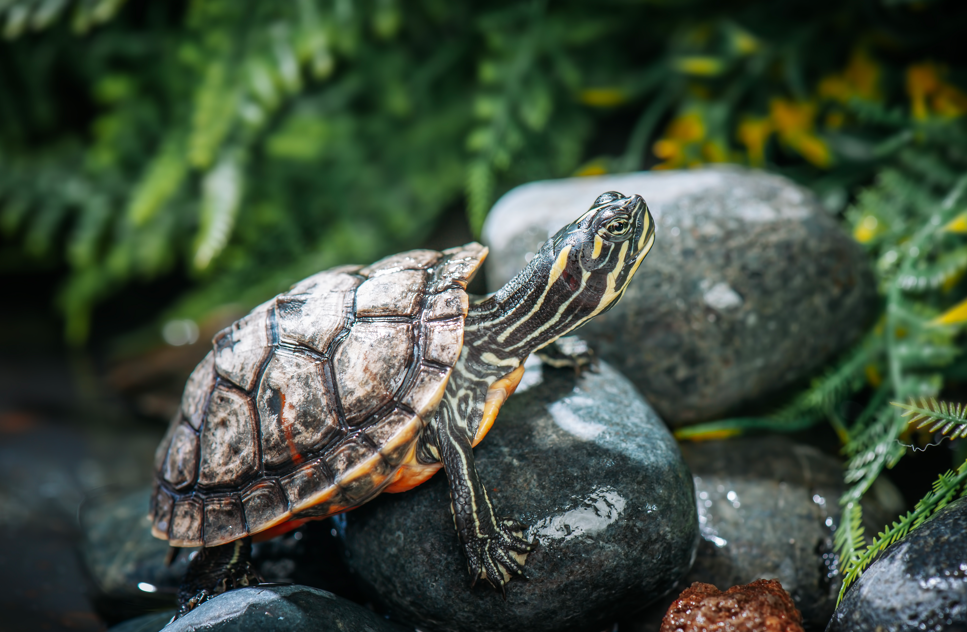
In Hong Kong, Red-eared Sliders, Chinese pond turtles, and various aquatic turtles are highly popular family pets. Many owners, during daily feeding or while cleaning the tank, often suddenly discover that their turtle’s face is swollen on one side. Right behind the eyes on both sides—the originally flat location of the tympanic membrane—a hard lump resembling a small hill or a ping-pong ball has bulged out. This sudden visual change frequently terrifies owners.
This type of abnormal swelling on the side of the head is highly inclined to be diagnosed as a turtle Ear Abscess, which is otitis media, in reptilian medicine. A turtle’s ear structure is different from that of mammals; they lack an external ear pinna and possess only a thin layer of tympanic membrane. Once bacteria invade, severe abscesses can easily form inside the ear canal. If left unmanaged, the abscess will continuously compress the eyeball and the oral cavity, causing the turtle to stop eating due to intense pain, and can even trigger a systemic infection.
Why is Your Turtle’s Face Swollen on One Side? Understanding Common Causes of Ear Abscesses
An ear abscess in turtles usually occurs when opportunistic pathogens in the environment travel retrogradely upward through the Eustachian tube (the passage connecting the middle ear to the oral cavity) into the middle ear, or when the tympanic membrane is injured, allowing bacteria to introduce directly from the outside. In Hong Kong’s husbandry environments, the following two factors are the primary causes inducing ear inflammation in reptiles:
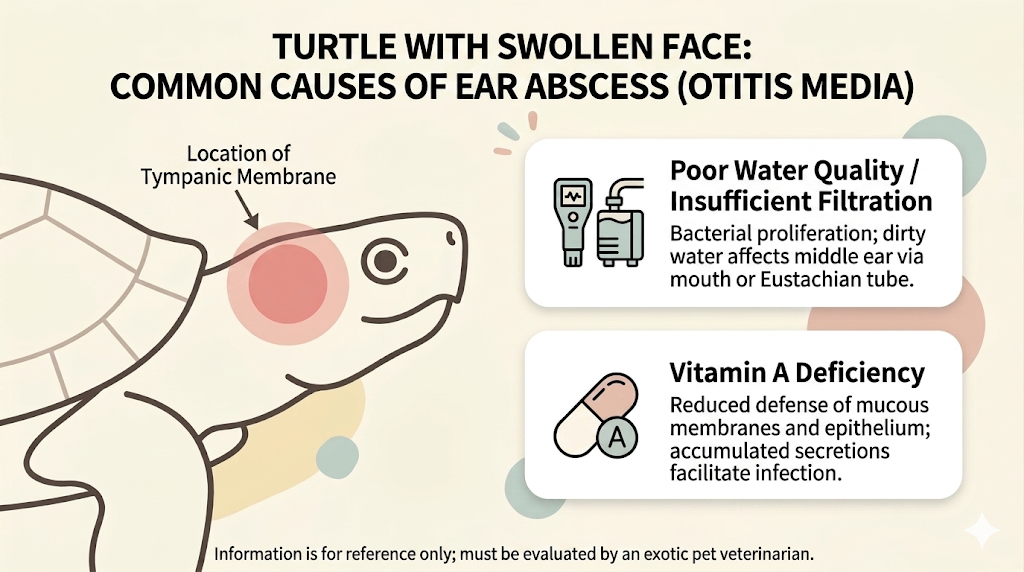
1. Unclean Water Quality and Suboptimal Filtration Systems
Aquatic turtles eat and excrete within the exact same water tank. If the enclosure space is cramped, combined with infrequent water changes or an underpowered filter, a massive amount of organic debris will accumulate in the tank. In this unclean water environment, pathogenic bacteria such as Gram-negative bacteria will proliferate wildly. When the turtle swims or dives, dirty water carrying a heavy bacterial load enters the middle ear via the oral cavity or damaged skin, triggering acute inflammation.
2. A Lack of Dietary Variety Leading to Vitamin A Deficiency
This is a nutritional pitfall that many novice owners easily overlook. If turtles are fed cheap dried shrimp or a single type of imbalanced commercial turtle food over a long period, they are highly prone to Vitamin A deficiency. The primary function of Vitamin A is to maintain the health of mucosal and epithelial tissues throughout the entire body. Under a chronic deficiency, the epithelial cells lining the inner ear canal undergo “squamous metaplasia,” losing their original self-cleaning and defensive functions. Secretions fail to drain and ultimately mix with bacteria to evolve into an abscess.
Common Symptoms of Turtle Ear Abscesses
Ear abscesses typically develop chronically, but they possess an exceptionally high level of recognizability in appearance. Owners can look out for the following symptoms:
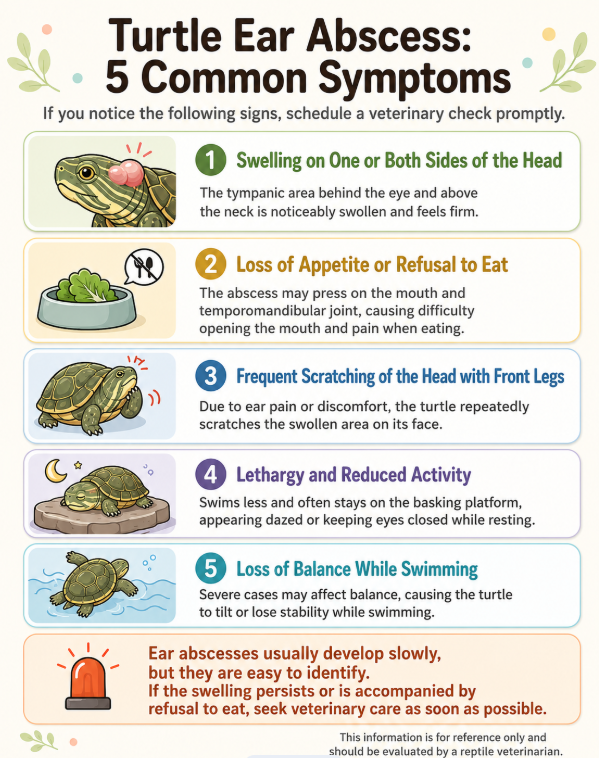
- Unilateral or bilateral head swelling: The tympanic membrane region behind the eyes and on the upper side of the neck bulges noticeably, feeling firm to the touch.
- Massive decline in appetite or complete refusal to eat: As the volume of the abscess expands, it severely compresses the temporomandibular joint (TMJ) and the interior of the oral cavity, making it difficult for the turtle to open its mouth and causing it to refuse food due to intense pain.
- Frequent scratching of the head with forelegs: Turtles will frequently scratch the swollen areas of their face with their forelimbs due to the throbbing pain or itching in the ear.
- Lethargy and decreased activity levels: Reducing their time swimming in the water, staying on the basking platform for long periods staring blankly, or resting with their eyes closed.
- Loss of balance when swimming: Severe bilateral otitis media or heavy unilateral compression can affect the turtle’s sense of balance, causing a slight tilt when swimming.
Why Medications Cannot Eliminate Abscesses: The Absolute Necessity of Surgical Debridement
Many owners, upon discovering their turtle’s swollen face, will attempt to purchase anti-inflammatory eye drops to drop onto the swollen area or add antibiotics into the water. However, clinically, these conservative treatments are virtually ineffective against an ear abscess that has already formed.
This is because the pus of reptiles is different from that of mammalian animals. When dogs, cats, or humans experience inflammation, the pus is mostly liquid; whereas the white blood cells of turtles lack certain hydrolytic enzymes, causing the pus generated by their inflammation to be extremely thick and viscous in texture, presenting as a Caseous Exudate resembling cheese or tofu dregs. This hard plug is tightly encapsulated by a tough layer of fibrous capsule that blood vessels cannot penetrate. Whether dealing with oral antibiotics or topical medications, the drug components are completely unable to penetrate into the interior of the abscess.
Therefore, surgical debridement for turtles is the necessary definitive curative method. The veterinarian must perform a surgical procedure to make a local incision into the tympanic membrane, use professional micro-instruments to thoroughly scoop out the hardened caseous pus mass inside, and execute deep sterile debridement along with localized medication to radically resolve the problem from its root.
Professional Veterinary Surgical Procedures and Post-Operative Daily Care
Veterinarians formulate a prudent protocol for turtles requiring ear abscess surgery:
Pre-Operative and Intra-Operative Management
The veterinarian will first conduct a detailed clinical evaluation to confirm the turtle’s physical fitness status. The surgery is performed under safe general anesthesia or localized analgesia. The veterinarian makes a tiny incision at the most prominent area of the swelling, removes the hard, yellowish-white caseous plug in its entirety, and flushes the middle ear cavity. Once debridement is complete, the incision is typically kept open to facilitate subsequent topical medication applications and the drainage of residual secretions.
Key Points of Post-Operative Home Care
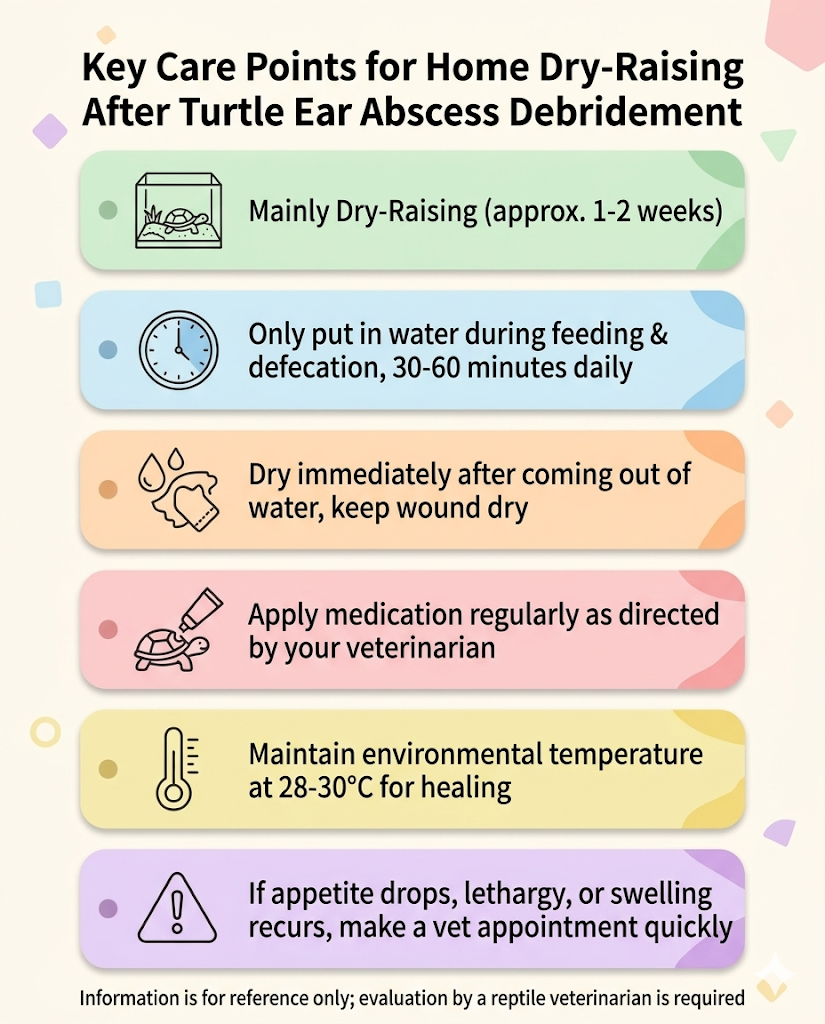
- Strictly execute “Dry-docking”: Within one to two weeks post-surgery, the turtle’s wound is not yet fully healed, and it absolutely must not be soaked in ordinary husbandry water for long periods; otherwise, dirty water entering the wound will trigger a severe secondary infection. Owners should house the turtle in a warm, dry enclosure lined with clean towels, allowing it into the water for only 30–60 minutes daily during feeding and defecation, and drying the wound immediately upon returning to land.
- Routine localized medication application: Adhere to medical advice, applying the veterinary prescribed ointment into the incision site at designated times daily.
- Environmental temperature control: During the post-op recovery phase, a heat lamp should be used to steadily maintain the ambient environmental temperature around 28–30°C. An appropriate temperature can substantially enhance the turtle’s own immunity and wound healing speed.
FAQ
My turtle’s face is swollen on one side. Can it reduce swelling and heal on its own without surgery?
It will not self-heal. As mentioned previously, the interior of a turtle’s ear abscess is filled with caseous necrotic tissue resembling “solid tofu dregs.” This substance cannot be absorbed by the body on its own. If a surgical incision is not performed to remove it, the abscess will only grow larger over time, eventually compressing the orbit to trigger blindness or eroding the lower jaw bones, leading to the turtle starving to death due to a long-term inability to eat. Early surgery is the sole method to halt the disease process.
Is the anesthetic risk high for a Red-eared Slider undergoing surgery for otitis media?
Accepting anesthesia carries a certain degree of risk for any animal, but for contemporary exotic medicine, reptilian anesthetic techniques have become highly mature. The veterinarian will precisely calculate the dosage based on the turtle’s weight and mental status, and utilize specialized micro-heating equipment as well as respiratory monitoring devices during surgery. As long as the turtle has not developed severe systemic organ failure or heavy dehydration prior to surgery, the anesthetic risk of the procedure itself is completely within a manageable range.
Why does a lack of Vitamin A in daily life trigger ear inflammation in reptiles?
Vitamin A is an indispensable nutrient for maintaining the health of the “epithelial cells” lining a turtle’s respiratory tract, oral cavity, and ear canals. When a turtle lacks Vitamin A long-term, the normal mucosal cells within the ear canal degrade and keratinize, causing the originally minor amounts of secretions inside the ear canal to fail to drain smoothly. These accumulated wastes become a breeding ground for bacteria, highly easily triggering inflammation that further evolves into a massive ear abscess.
Will the ear abscess recur after a turtle undergoes surgical debridement and recovers?
There is a chance it can. Surgical excision can only clear the plug that has already formed this time. If the owner’s husbandry concepts do not change after surgical recovery, bacteria will rapidly invade again, leading to a recurrence. Therefore, adjusting to a correct environment and dietary structure post-surgery is the key to preventing recurrence.
CityVet Turtle & Reptile Clinic
CityVet is committed to providing outstanding comprehensive veterinary care, guided by the core values of professionalism, compassion, and trust. We aim to offer reasonable fees, introduce advanced equipment, and explain treatment options clearly to pet owners, so that every pet receives full medical support.
To book an examination for a facial lump on your turtle or consult on a reptile evaluation, please call our Tsuen Wan branch at 2623 5500 or our Yuen Long branch at 2477 9990. Address: G/F, 186 Sha Tsui Road, Tsuen Wan / Shop 2, G/F, Fuk Shun Building, 25 Ping Wui Street, Yuen Long.
Disclaimer
This article is for general information only and does not replace professional medical diagnosis. If you have any concerns, please book a veterinary examination as soon as possible.