

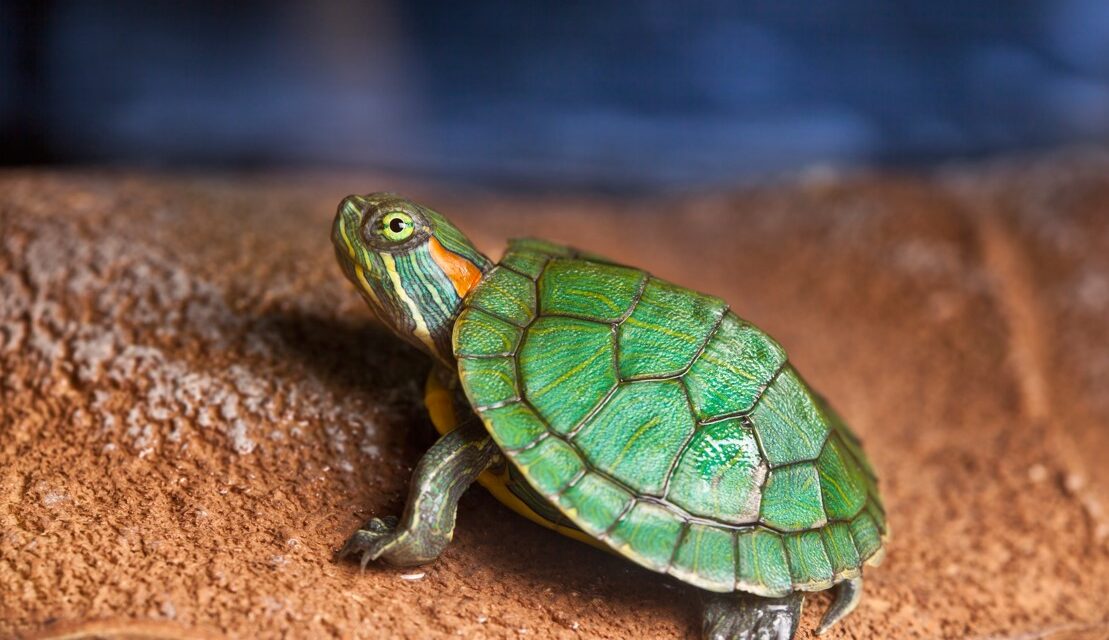
In Hong Kong, many owners treat “turtles” as entry-level exotic pets, but aquatic turtles actually have high demands regarding their environment, temperature, lighting, and nutrition. If kept in improper conditions, they are prone to serious problems such as respiratory infections (pneumonia), reproductive organ or rectal prolapse, refusal to eat (anorexia), and egg binding.
Below, we will first explain the key points of the aquatic turtle housing environment, and then, through a real case of “reproductive organ prolapse + egg binding,” remind owners that medical attention must be sought immediately once dangerous situations arise.
Correct Aquatic Turtle Housing Environment: Nutrition + Environment are Equally Important
Many problems actually accumulate slowly due to “inadequate environmental facilities.” The health of an aquatic turtle relies on several core principles:
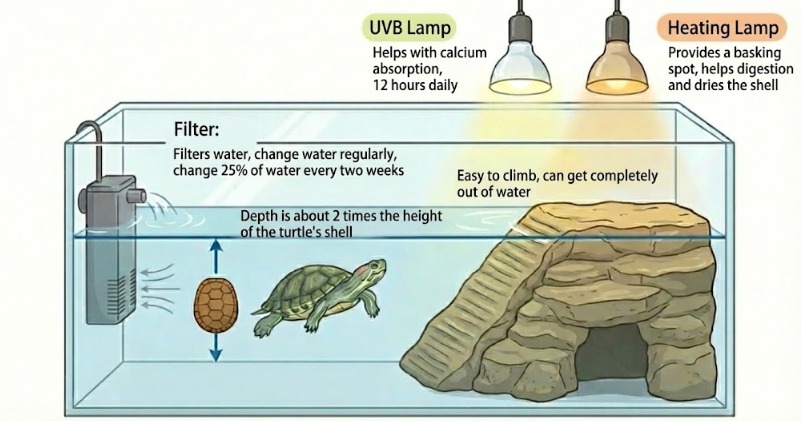
Must be kept in a fish tank or turtle tank
- It is not recommended to keep them in “small basins” or environments with “only a little water.”
- There must be enough space for the turtle to swim freely, turn around, and climb ashore to bask.
Water Level Height: At least “two turtle backs” deep
- It is generally recommended that the water level be no lower than 2 times the height of the turtle’s shell, allowing it to truly swim rather than just struggle on the water surface.
- At the same time, ensure there is a stable floating platform or landing area so the turtle can easily climb up, preventing it from gasping in the water for long periods.
Filtration System and Water Change Frequency
- It is recommended to equip the tank with a filter of appropriate flow rate to maintain water cleanliness and reduce ammonia and fecal accumulation.
- With a good filtration system, a daily full tank water change is generally not necessary. You can instead:
- Regularly siphon out some dirty water and top up with fresh water;
- Adjust the water change frequency based on the amount of feces, feed, and water quality.
- When adding water, avoid drastic temperature changes to prevent subjecting the turtle to cold shock.
UVB Lamp and Daylight Hours
- A UVB lamp is critical equipment for aquatic turtle care, aiding in calcium absorption and maintaining skeletal and shell health.
- Recommendations:
- Provide about 12 hours of light daily (simulating the circadian rhythm).
- Replace the UVB bulb approximately every six months; even if it still emits light, the UVB intensity will gradually decrease.
- Combine with a heat lamp or heating equipment to keep the basking platform at a higher temperature, encouraging the turtle to come ashore and bask.
Diet and Nutrition
- Use high-quality turtle pellets as the staple food, supplemented with an appropriate amount of fresh vegetables and occasional protein (e.g., small fish/insects). Avoid feeding only dried shrimp or a single type of food.
- Control food portions to avoid overfeeding, which leads to obesity, fatty liver, or increased risk of egg binding.
- Different species (aquatic turtles / semi-aquatic turtles / tortoises) actually have different nutritional needs; it is recommended to have them assessed by a veterinarian or professional.
Introduction to Common Aquatic Turtle Diseases
Respiratory Infection (Pneumonia)
Mostly caused by water temperatures being too low, a humid environment where the turtle cannot dry off completely, or sudden exposure to cold. Common symptoms include:
- Floating with head up, gasping, open-mouth breathing
- Discharge from nostrils, sneezing
- Body tilting while swimming (may be related to the lungs or middle ear)
- Decreased activity, refusal to eat, poor spirit
- Such situations require early medical attention and may necessitate imaging and medication.
Reproductive Organ or Rectal Prolapse
Common causes for prolapse in aquatic turtles include:
- Constipation, intestinal problems
- Urinary or reproductive tract diseases
- Chronic straining to defecate, urinate, or lay eggs
- Abnormalities in the pelvic or surrounding structures
- If prolapsed tissue is exposed for a long time, it will become necrotic due to drying and restricted blood flow; this is an emergency.
Refusal to Eat (Anorexia)
Refusal to eat is not a single disease, but a warning sign:
- Unsuitable environmental temperature or lighting
- Stress from a new environment
- Oral, digestive, parasitic, or systemic diseases
- Female turtle preparing to lay eggs, egg binding
- If refusal to eat persists for several days to a week, assessment by a veterinarian is recommended.
Egg Binding (Dystocia)
If a sexually mature female turtle has eggs in her body but cannot lay them smoothly, she may appear:
- Restless/anxious, repeatedly trying to dig holes but not laying eggs
- Abdomen slightly distended or hard to the touch
- Decreased activity, loss of appetite
- Some cases may be accompanied by reproductive organ or rectal prolapse
- If egg binding is left untreated, it can lead to infection, rupture, or pressure on internal organs, potentially endangering life.
Real Case Sharing
The following is a real case shared to remind owners of the importance of seeking medical attention early.
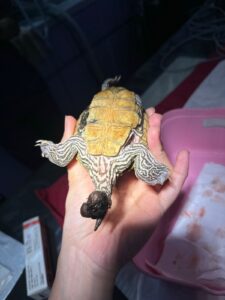
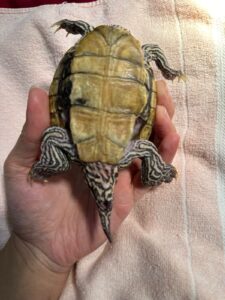
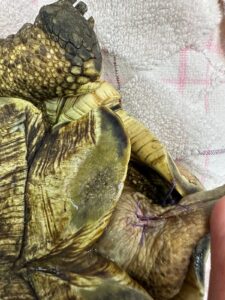
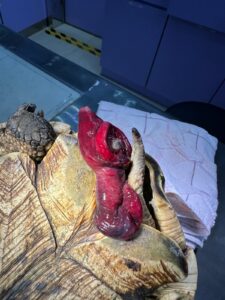
Initial Consultation: Reproductive Organ/Rectal Prolapse
When a turtle was brought to the clinic, the owner found a mass of red tissue protruding from its anal region, appearing to be a reproductive organ/rectal prolapse. The owner noted that for several days the turtle had:
- Lower activity levels than usual
- Decreased appetite
- Occasional posturing as if straining to defecate
Emergency Treatment: Keeping Prolapsed Tissue Moist and Temporary Suturing
The medical team’s first priority was to protect the exposed tissue as much as possible:
- Used saline and lubricant to keep the surface moist and clean, preventing cracking and further trauma.
- After assessing the turtle’s overall condition, attempted a purse-string suture around the anus to temporarily stitch it, aiming to reposition the prolapsed part as much as possible while preserving space for defecation.
- At the same time, the doctor actively sought the root cause of the prolapse.
Imaging: X-ray Reveals Massive Egg Retention
Subsequent X-ray examination clearly showed multiple turtle eggs inside the body, lined up in the abdominal cavity but failing to be expelled. In other words, this was not a simple “anal problem,” but a complication caused by egg binding.
Surgical Treatment: Laparotomy for Egg Removal and Spaying
After discussion with the owner, the medical team arranged an abdominal surgery for the turtle:
- Under strict anesthesia and monitoring, the abdomen was opened at the appropriate location to remove the retained eggs one by one.
- Related reproductive organ issues were addressed simultaneously by performing a spay surgery to reduce the risk of similar occurrences in the future.
- Post-surgery care involved pain relief, antibiotics, keeping warm, and quiet rest, along with regular follow-up checks on the wound and recovery status.
Fortunately, the case recovered ideally after surgery. With proper care and adjustments to the housing environment, the turtle’s quality of life improved significantly.
Case Key Points
- Once a reproductive organ or rectal prolapse occurs, it is an emergency; do not delay.
- When transporting to the hospital, keep the prolapsed part moist with clean wet gauze or saline. Avoid trying to roughly push it back yourself.
- Many external issues are actually related to internal diseases (e.g., egg binding, severe constipation) and require imaging and further examination to confirm.
- After surgery, correct housing environment and nutrition are still required; otherwise, risks of recurrence and other diseases remain.
When should you immediately take your turtle to the vet?
It is recommended to book an appointment for assessment immediately if any of the following occur:
- Rapid breathing, open-mouth breathing, floating with head up for noticeably longer periods.
- Eyes closed for long periods, reluctance to swim, persistent refusal to eat.
- Tissue protruding from the anus or cloaca, bleeding, or foul odor.
- Female turtle showing obvious nesting behavior (digging/looking for a spot) but still hasn’t laid eggs after several days.
- Any unexplained swelling, wounds, or abnormal discharge.
- Early diagnosis and treatment can often reduce surgical risks and shorten recovery time.
Daily Care Tips
- Regular Checks: Observe weight, appetite, activity level, and breathing.
- Maintain Temperatures: Keep appropriate water temperature and basking temperature; avoid sudden hot and cold fluctuations.
- Balanced Diet: Provide a balanced diet for the turtle, adjusting the plant-to-protein ratio according to the species.
- Consultation: If novice owners are unsure about tank equipment configuration (filter, water level, UVB, floating platform), they can bring photos or videos to the clinic for consultation.
Common Questions (FAQ)
Q1: Must aquatic turtles have a UVB lamp? Is basking by the window okay?
In most cases, a UVB lamp is recommended because glass windows significantly reduce UVB penetration, and weather is unstable. UVB is very important for calcium absorption and shell/bone health.
Q2: Will high water levels cause the turtle to drown?
As long as the turtle is healthy and there is a stable floating platform or landing spot in the tank, the water level should not be too shallow. Water that is too low prevents them from swimming normally and makes them prone to injury or difficulty turning over.
Q3: Why do you say frequent “full tank water changes” aren’t needed?
With a good filter and regular partial water changes, it is usually unnecessary to change the whole tank daily, avoiding temperature shock or excessive stress. However, if the water is obviously cloudy, smelly, or has high ammonia levels, it must be dealt with actively.
Q4: If I see a reproductive organ/rectal prolapse, how can I perform first aid at home?
You can use clean gauze soaked in saline or cool boiled water to gently cover the prolapsed tissue to keep it moist. Arrange for medical attention as soon as possible; do not roughly push it back yourself.
Q5: Is surgery mandatory for egg-bound female turtles?
It depends on the location and number of eggs, the turtle’s overall condition, and imaging results. Some mild cases may be helped to lay eggs by adjusting the environment, medication, or other methods, but severe or long-term retention often requires surgical intervention.
Professional Exotic Pet Medical Care: Providing Comprehensive Care for Your Turtle
Cityvet is committed to providing outstanding comprehensive veterinary medical services, upholding the core values of “professionalism, care, and trust,” providing reasonable charges, introducing advanced instruments, and explaining treatment methods in detail to owners to provide comprehensive medical care for every pet. Want to book an appointment for the turtle clinic? Please call the Tsuen Wan branch at 2623 5500 or the Yuen Long branch at 2477 9990. Address: G/F, 186 Sha Tsui Road, Tsuen Wan / Shop 2, G/F, Fuk Shun Building, 25 Ping Wui Street, Yuen Long.
Disclaimer: This article provides general information only and cannot replace professional medical diagnosis. If in doubt, please book a veterinary examination as soon as possible.