

The heart is the core engine that keeps life going. However, just like humans, our pet cats and dogs can also be plagued by heart problems. Pet heart disease is often difficult to detect in the early stages. By the time the symptoms become obvious, the condition may have already progressed to a later stage. Fortunately, with modern veterinary diagnostic tools, especially “cardiac ultrasound,” we can diagnose problems early and accurately, create effective management plans for our pets, slow down the worsening of the condition, and improve their quality of life.
Pet Heart Disease: An Invisible Health Threat
Pet heart disease refers to any abnormality that affects the heart’s structure or function. It can be congenital (present at birth) or acquired (caused by old age or other factors). It can weaken the heart’s efficiency in pumping blood, leading to insufficient blood and oxygen supply to various organs in the body. In severe cases, it can even cause heart failure, which is life-threatening.
Common Symptoms of Heart Disease in Cats and Dogs
The symptoms of heart disease can be subtle, and owners need to observe carefully.
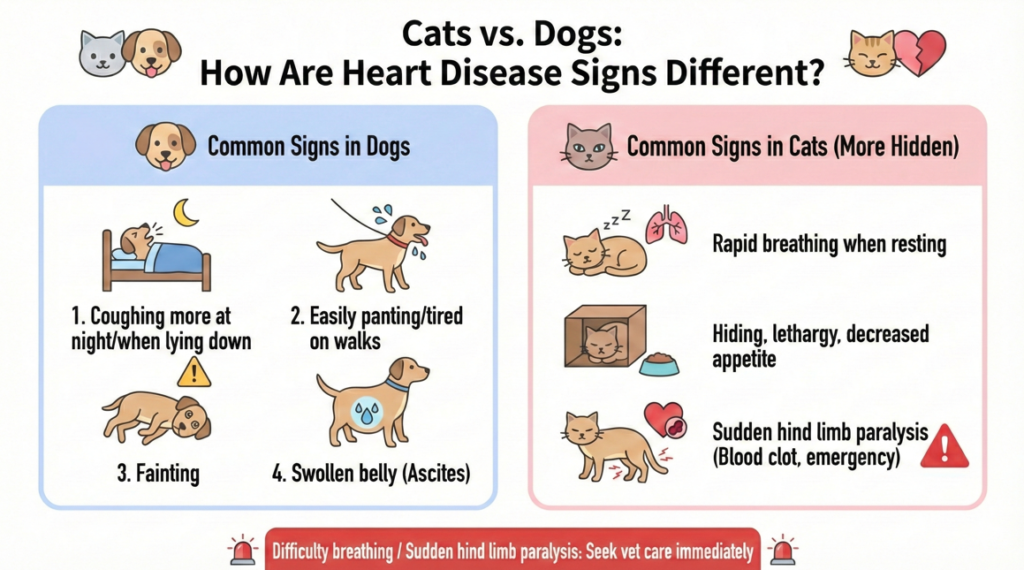
Common Warning Signs of Heart Disease in Dogs
- Coughing: Especially when it worsens at night, when lying down, or after excitement. This is a classic symptom of left-sided heart failure.
- Exercise Intolerance: Getting tired or out of breath easily during a walk, and not wanting to move around.
- Difficulty or Rapid Breathing: The breathing rate is fast even when resting.
- Fainting: Especially during exercise or excitement.
- Abdominal Bloating: Caused by fluid accumulation due to right-sided heart failure.
- Pale or bluish gums.
Common Warning Signs of Heart Disease in Cats (More Hidden!)
Cats are very good at hiding illness, and the symptoms of heart disease are often even harder to detect until a serious complication occurs.
- Rapid or Difficulty Breathing: This is the most common symptom, but owners may mistake it for the cat just resting.
- Lethargy, Hiding, Loss of Appetite.
- Sudden Hind Limb Paralysis and Severe Pain: This is caused by a blood clot (Aortic Thromboembolism, ATE) triggered by heart disease and is an extremely critical situation.
- (Less Common) Coughing or Fainting.
Common Types of Heart Diseases in Cats and Dogs
- Dogs: Mitral Valve Degenerative Heart Disease (MMVD) This is the most common acquired heart disease in dogs, especially small, senior dogs (such as poodles and Cavalier King Charles Spaniels). The mitral valve on the left side of the heart cannot close completely due to degeneration, causing blood to flow backward and increasing the heart’s workload.
- Cats: Hypertrophic Cardiomyopathy (HCM) This is the most common heart disease in cats. The heart muscle in the ventricular wall becomes abnormally thickened, which reduces the volume of the ventricle and affects the heart’s ability to relax and pump blood. Breeds like Ragdolls and Maine Coons have a higher genetic risk.
Heart Disease Diagnosis Process: How Do Vets Find the Problem?
When a veterinarian suspects your pet has a heart problem, they will recommend a series of tests to confirm the diagnosis.
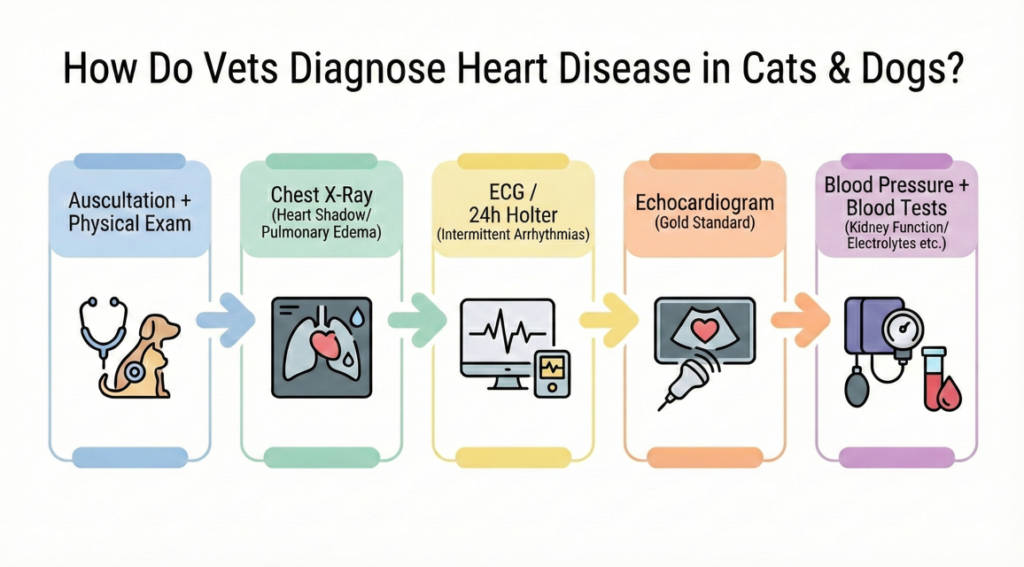
- 1. Auscultation and Physical Exam The vet will use a stethoscope to listen carefully to the heart and check for a heart murmur, arrhythmia, or other abnormal sounds.
- 2. Chest X-ray An X-ray can show the overall size and shape of the heart (the cardiac silhouette) and can evaluate the lungs for signs of fluid accumulation (pulmonary edema), which is a common complication of heart failure.
- 3. Electrocardiography (ECG) & 24-Hour Holter Monitoring
An ECG records the electrophysiological activity of the heart and is primarily utilized to diagnose arrhythmias (irregular heartbeats).
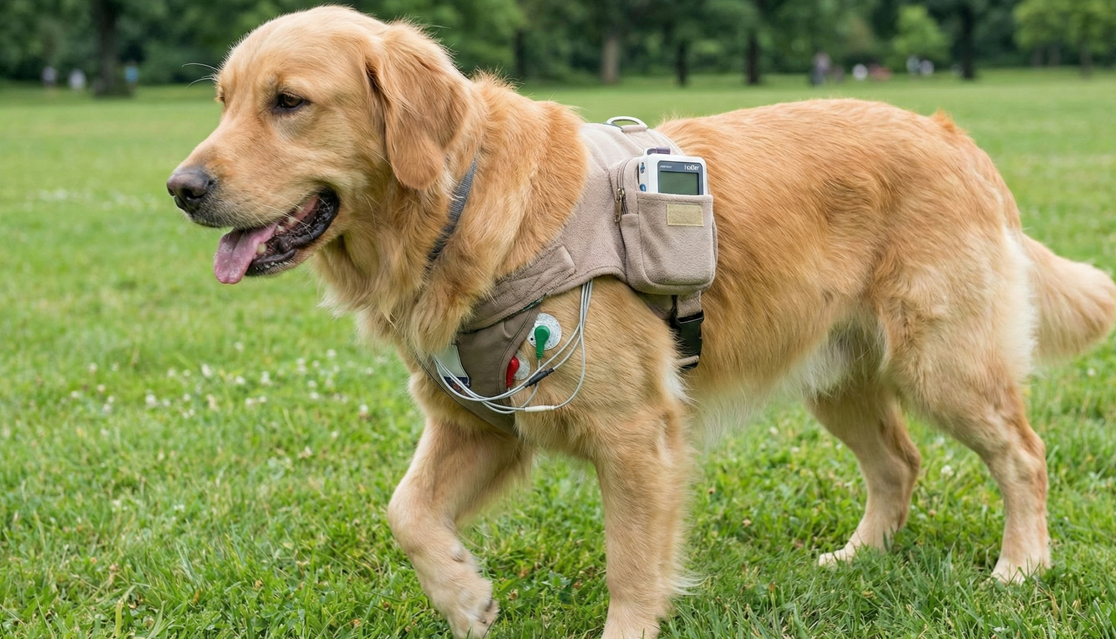
If clinical symptoms are “intermittent”—such as occasional syncope (fainting), sudden dyspnea (shortness of breath), or acute bouts of lethargy—a standard ECG may fail to capture the abnormality. In such cases, a veterinarian may recommend 24-hour Holter Monitoring:
- Continuous Monitoring: The pet wears a specialized chest-strap harness that houses the monitoring device.
- Non-Invasive: The procedure is entirely painless and non-invasive, allowing for continuous recording during the pet’s normal daily activities.
- Comprehensive Data: By recording the heart rhythm and rate changes over a full 24-hour period, clinicians can better understand the frequency, timing, and severity of any underlying arrhythmias.
- 4. Cardiac Ultrasound (Echocardiogram): The Gold Standard for Diagnosis This is the most important tool for diagnosing most heart diseases. It uses an ultrasound probe to provide real-time, dynamic images of the heart.
- 5. Blood Pressure Measurement
Blood pressure readings are a vital indicator of the overall state of the circulatory system. Hypertension (high blood pressure) or hypotension (low blood pressure) can significantly impact cardiac workload and systemic perfusion. These fluctuations may also be linked to concurrent issues, such as renal (kidney) or endocrine disorders.
By measuring blood pressure, the veterinarian can evaluate the impact of heart disease on systemic circulation and monitor changes during treatment to ensure medication safety and therapeutic stability.
- 6. Blood Panels: Assessing Complications and Ruling Out Comorbidities
Blood tests are used to evaluate the pet’s general health, identify complications secondary to heart disease, and rule out other conditions that may mimic cardiac symptoms or influence treatment options. Key assessment areas include:
- Renal Function & Electrolytes: Many cardiac medications (particularly diuretics) can alter fluid and electrolyte balance; therefore, regular monitoring of kidney values is essential.
- Liver Function: Assessing the liver ensures the body can safely metabolize medications.
- Complete Blood Count (CBC): This identifies issues like anemia, infection, or inflammation, all of which can exacerbate the heart’s workload or complicate the clinical presentation.
- Endocrine Markers: Tests for conditions such as thyroid dysfunction are crucial, as hormonal imbalances can lead to tachycardia (elevated heart rate) or place undue strain on the cardiovascular system.
An In-Depth Look at Cardiac Ultrasound
- Why is Cardiac Ultrasound So Important?
- An X-ray can only show the heart’s silhouette, but a cardiac ultrasound allows us to “see through” the heart’s internal structure and evaluate its function:
- Measures heart wall thickness and ventricular size: The key to diagnosing HCM or Dilated Cardiomyopathy (DCM).
- Evaluates heart valve structure and movement: Directly observes whether the valves are thickened, prolapsed, or not closing properly (such as in MMVD).
- Detects blood flow: Uses color Doppler to detect abnormal blood backflow or turbulence.
- Evaluates heart contractility: Calculates how much blood the heart pumps out each time to assess the strength of the heart muscle.
In short, a cardiac ultrasound is the only non-invasive test that can accurately distinguish between different types of heart disease, evaluate the severity, and provide the most crucial information for creating a treatment plan.
- What is the procedure like? The pet will be positioned on its side or standing on a soft pad. The vet will shave a small area of fur on its chest, apply gel, and then use the probe to scan. The whole process usually takes 30 to 60 minutes, and most pets do not need sedation or anesthesia.
Treatment and Management of Cat and Dog Heart Disease
Most acquired heart diseases cannot be “cured,” but they can be effectively managed with medication. The treatment goals are:
- To slow down the onset of heart failure.
- To control clinical symptoms (such as coughing and shortness of breath).
- To improve the pet’s quality of life.
Commonly used medications include diuretics (to help excrete excess fluid), vasodilators (to reduce the heart’s workload), and drugs that strengthen heart muscle contraction. Based on the results of the cardiac ultrasound and other tests, the vet will create the most suitable combination of medications for your pet, which will need to be taken for life with regular follow-up visits.
Frequently Asked Questions (FAQ)
Q1: How much does a cardiac ultrasound for a pet cost?
A1: In Hong Kong, the cost of a pet cardiac ultrasound varies depending on the clinic’s equipment and whether a veterinary cardiologist performs it, and generally ranges from HK2,000toHK5,000 or more. It is recommended to contact the clinic directly for a detailed price list.
Q2: Can heart disease be cured?
A2: For most acquired heart diseases (such as MMVD and HCM), there is currently no cure. However, they can be effectively managed long-term with medication and care, allowing pets to maintain a good quality of life for many years. Some congenital heart diseases may be corrected with surgery.
Q3: Is anesthesia needed for a cardiac ultrasound?
A3: In the vast majority of cases, it is not needed. It is a non-invasive, painless examination, and most pets can cooperate while awake. Only a very small number of pets that are extremely nervous or aggressive may need mild sedation.
Q4: Is heart disease hereditary? Which breeds are at a higher risk?
A4: Yes, some heart diseases have a clear breed predisposition. For example, Cavalier King Charles Spaniels, miniature poodles, and dachshunds are a high-risk group for MMVD. Maine Coons, Ragdolls, and British Shorthairs are a high-risk group for HCM.
Q5: My pet has been diagnosed with heart disease. What should I be aware of for daily home care?
A5: You must give them their medication on time. Avoid letting them get too excited or do strenuous exercise. Monitor their resting respiratory rate (RRR). A normal rate should be less than 30-35 breaths per minute. If it is consistently high, you should contact a vet. They may also need to switch to a low-sodium prescription diet.
Early Diagnosis and Heartfelt Care for Every Beat
Cityvet is committed to providing outstanding comprehensive veterinary medical services, upholding the core values of “professionalism, care, and trust.” We aim to offer reasonably priced services, utilize advanced equipment, and provide detailed explanations of various treatment methods to owners, ensuring comprehensive medical care for every pet.
Suspect your pet has a heart problem? Want to book a cardiac health check? Please call the Tsuen Wan clinic at 2623 5500 or the Yuen Long clinic at 2477 9990. Addresses: G/F, 186 Sha Tsui Road, Tsuen Wan / G/F, Fuk Shun Building, 25 Ping Wai Street, Yuen Long.
Disclaimer: This article provides general information only and is not a substitute for professional medical diagnosis. If you have any concerns, please schedule a veterinary appointment as soon as possible.