

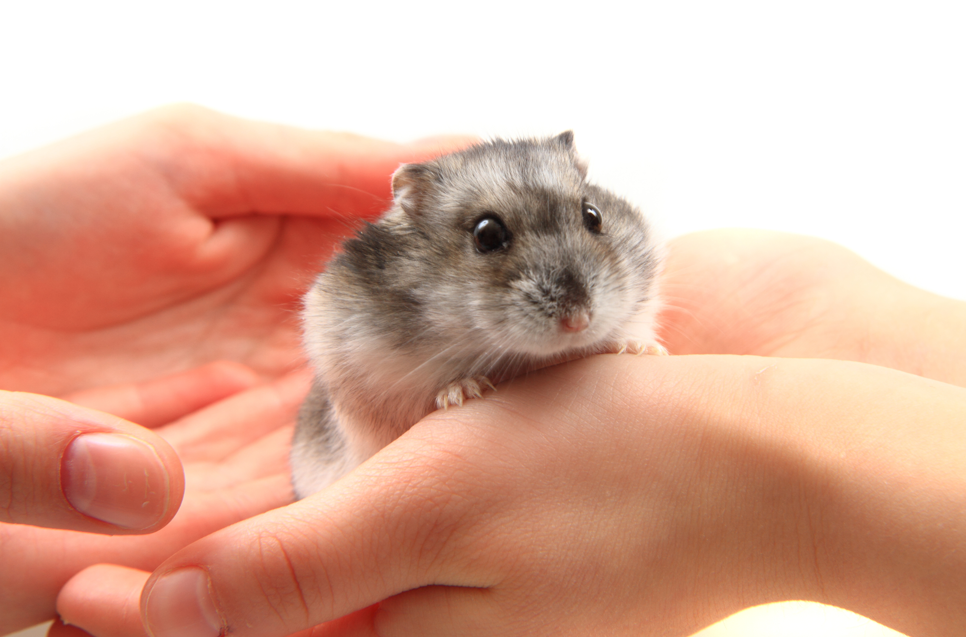
Small rodent animals like hamsters and fancy rats have relatively short lifespans and exceptionally fast metabolic rates. When they step into their middle-to-senior years (typically 1.5 years old or above), strange hard lumps often pop up suddenly across various parts of their bodies. Many owners, during daily handling or grooming, suddenly discover a lump on their pet’s back, abdomen, or armpit, and often immediately associate it with cancer, falling into a panic.
In reality, discovering a lump on a hamster is not entirely synonymous with an incurable disease. In small animal clinical medicine, these subcutaneous protrusions are primarily divided into two major categories: one is a bacterial “abscess” caused by wound infection, and the other is a “true tumor” formed by abnormal cell proliferation. The treatment direction and prognosis for the two are entirely different; learning to differentiate them initially helps owners remain calm and seek professional veterinary assistance early on.
What is a Bacterial “Abscess”? Common Causes and Appearance
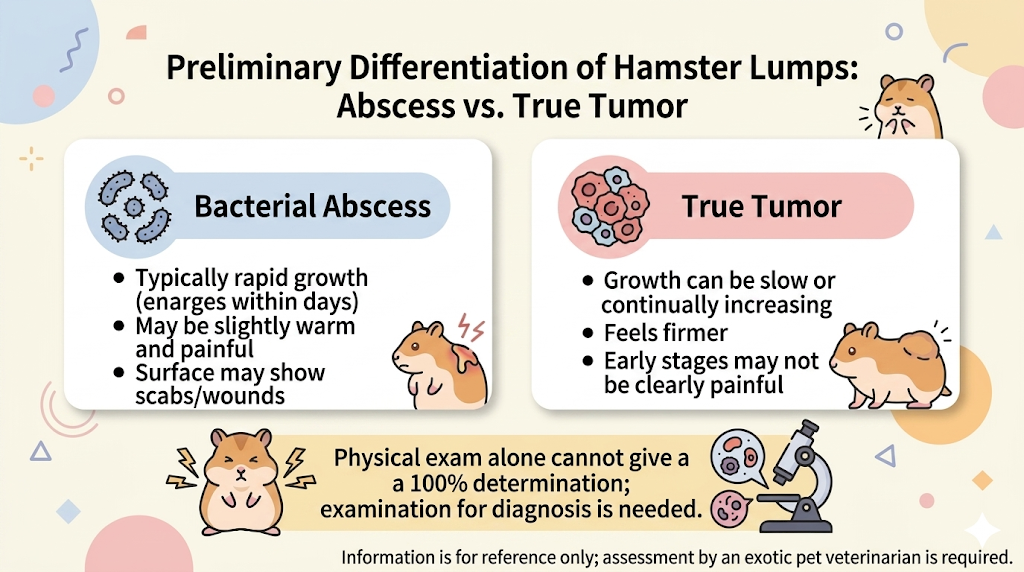
A bacterial abscess is simply a “large inflammatory sac” encapsulated with a massive amount of pus. Hamsters are naturally lively, love to burrow, and some individuals possess strong territorial instincts.
Common Causes
- Wound Infection: The appearance of a sarcoma or lump on a hamster or rat often stems from fight bite wounds, or being pierced by sharp wood shavings or toys within the enclosure. Pathogens dive deep into the subcutaneous layers, and the body’s immune system dispatches white blood cells to combat them, ultimately mixing with necrotic tissue and bacteria to form a thick, viscous pus.
- Cheek Pouch Inflammation Spread: Food pierces the inner wall of the cheek pouch, and bacteria directly spread under the skin of the face or neck, forming a massive abscess.
Appearance and Tactile Characteristics
The growth rate of an abscess is typically extremely fast, capable of swelling to the size of a ping-pong ball within just two to three days. It usually feels slightly warm to the touch, and hamsters will struggle due to pain when it is pressed. A black scab (the original entry point of the injury or wound) can sometimes be seen on the surface of the abscess.
What is a “True Tumor”? The Difference Between Benign and Malignant
A true tumor is a solid mass generated by cellular gene mutations and unrestricted, rampant proliferation. Rodents (especially fancy rats and laboratory rats) are highly prone groups for tumors.
Common Classifications
- Benign Tumors: Such as lipomas or early-stage mammary tumors. The growth rate is relatively slow, borders are clear, and they feel like they can glide under the skin, usually not directly threatening life.
- Malignant Tumors (Cancer): Such as lymphomas or cutaneous fibrosarcomas. The growth rate is astonishing, invading surrounding tissues with blurred borders, and the mass cannot be easily shifted. In later stages, they may rupture and bleed, severely consuming the hamster’s physical energy.
Appearance and Tactile Characteristics
Tumors typically feel harder and colder in texture, and in the initial stages, hamsters do not exhibit any obvious sensation of pain.
How Veterinarians Scientifically Differentiate and Diagnose
Relying on the naked eye and finger palpation alone, even highly experienced veterinarians cannot provide a 100% definitive diagnosis. Therefore, heading to a clinic for a professional screening is an indispensable step.
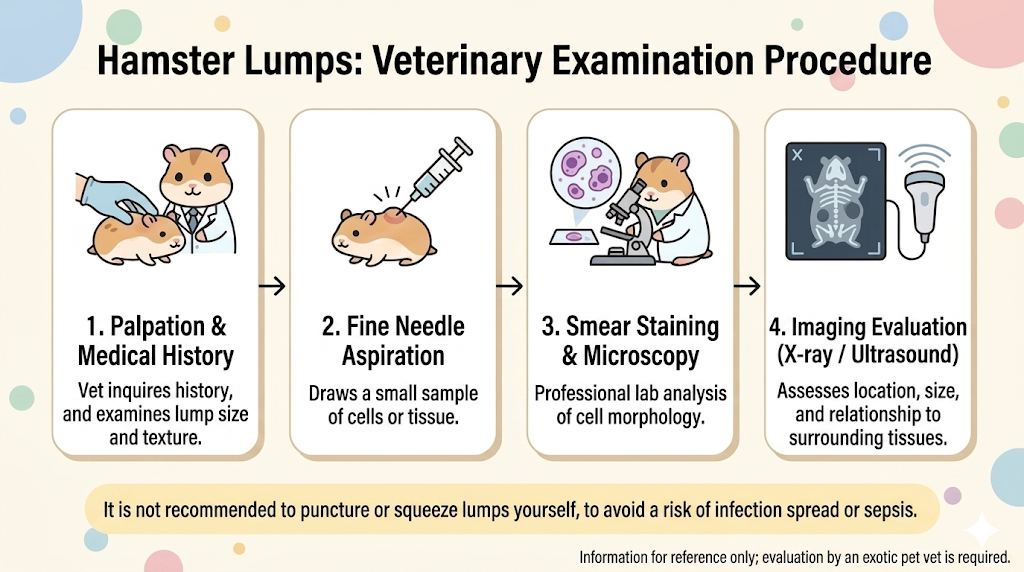
Veterinarian typically employs the following safe, minimally invasive examination methods:
- Fine Needle Aspiration Cytology (FNA): The veterinarian will use an extremely fine needle to gently pierce the lump and extract a small amount of cells or fluid. If thick yellow-white or green pus is drawn out, an abscess can be definitively diagnosed; if no liquid can be drawn and only scattered cells are collected, the smear will be stained to observe cell morphology under a microscope to evaluate whether it is a true tumor.
- Diagnostic Imaging (X-Ray / Ultrasound): Evaluating whether the lump has invaded downward into the muscle layers or bones, which is paramount for planning the scope of small animal surgery.
Treatment Directions: Debridement Surgery and Tumor Excision
Once a diagnosis is confirmed, the veterinarian will formulate an appropriate treatment pathway based on the nature of the lump:
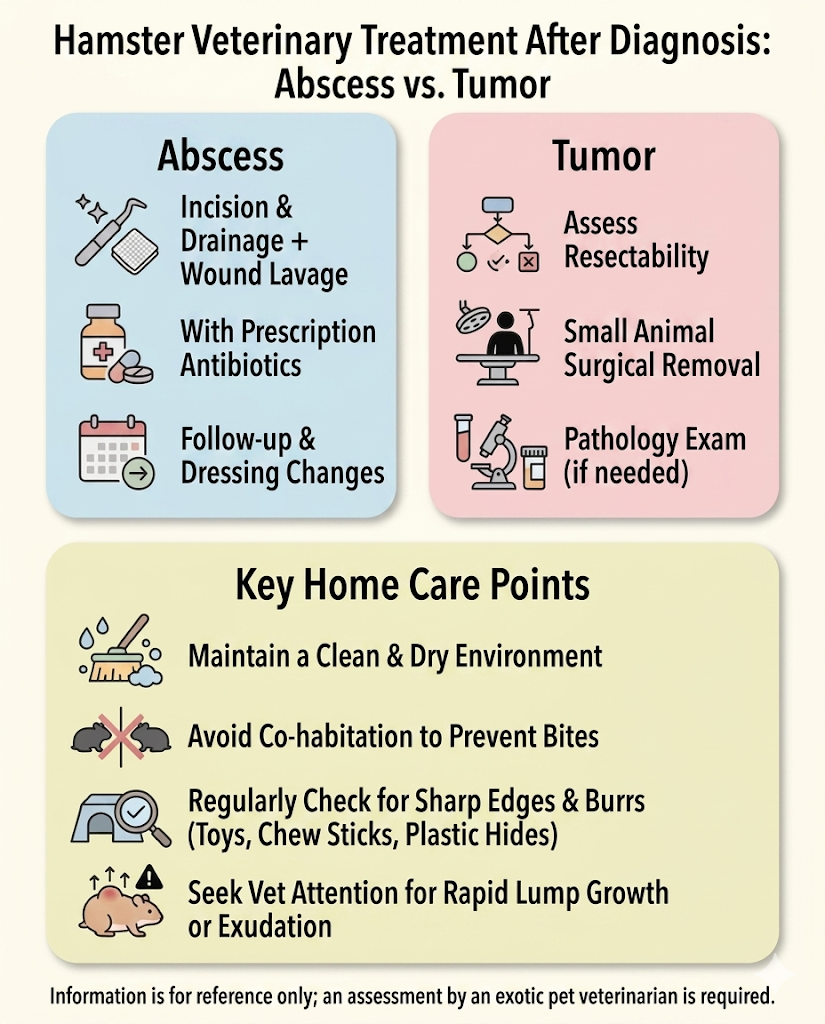
1. Treatment of Abscesses: Incision, Drainage, and Debridement
The pus in hamsters is extremely thick and viscous (resembling cheese); it cannot be drained cleanly solely by taking antibiotics or using a needle. Veterinarians typically need to perform local or general anesthesia to incise the abscess, thoroughly scrape away the internal necrotic tissues, and perform repeated flushes with sterile normal saline, finally placing drainage or matching it with oral antibiotics to control inflammation.
2. Treatment of Tumors: Small Animal Surgical Excision
For benign tumors or malignant tumors that have not yet metastasized, surgical excision is the only definitive curative method. With advancements in modern veterinary anesthesia techniques and micro-surgical instruments, as long as the hamster’s physical fitness, cardiac, and pulmonary functions pass evaluation, early excision of small-volume tumors yields a remarkably high success rate.
Daily Care and Enclosure Safety Prevention
To minimize the chance of a hamster developing lumps, owners should address environmental safety:
- Implement a Strict Solitary Housing System: The vast majority of hamsters (such as Campbell’s, Winter White, and Roborovski hamsters) possess strong territorial instincts once they grow up; co-housing highly easily triggers bite wound abscesses.
- Investigate Sharp Objects in the Cage: Routinely check chewing wood and plastic hideouts for any sharp edges that poke the hands, preventing fur babies from scratching their skin while running.
FAQ
The lump on my hamster is growing very fast, is it a malignant tumor?
Not necessarily. A fast growth rate is actually a classic characteristic of a bacterial “abscess,” because heavy bacterial proliferation and pus accumulation often require only 24 to 72 hours. Certain benign mammary tumors in small animals can also grow rapidly due to hormonal stimulation. To differentiate the nature, the pet must be brought to a clinic for a fine needle aspiration test by a veterinarian.
Can I use a needle to puncture and squeeze out the abscess for my hamster at home by myself?
Absolutely not! A hamster’s skin is extremely thin, and the pus inside their bodies is highly viscous in texture. Puncturing it with a needle at home on your own not only fails to evacuate the pus but will introduce secondary external bacteria deep into the subcutaneous layers. Forceful squeezing will trigger intense pain and can even cause bacteria to enter the blood circulation, triggering acute septicemia. All debridement procedures must be handled by a professional veterinarian under sterile operations.
For such a tiny hamster, is surgery to excise a tumor safe?
Any surgery and anesthesia carry a certain degree of risk. However, modern exotic medicine has introduced highly precise gas anesthesia systems, micro-electrocautery hemostasis equipment, and intraoperative thermal support devices. If the tumor is still small, has not metastasized, and the hamster is in good physical shape, the risk of timely small animal surgery is completely manageable. Conversely, if you choose to wait and watch, allowing the tumor to grow until it compresses blood vessels or ruptures, the anesthetic risk at that time will increase exponentially.
How can I prevent a hamster or fancy rat from developing bacterial abscesses?
The most effective preventive method is keeping the environment absolutely safe and hygienic. Avoid co-housing to prevent bite injuries; routinely trim sharp edges of wooden or plastic toys inside the cage; choose soft, splinter-free, high-quality paper bedding to reduce the chance of sharp dry hay scratching the skin. If minor wounds are found on the hamster daily, contact a veterinarian promptly to use safe, pet-specific disinfectants.
CityVet Small Animal Surgery & Oncology Clinic
CityVet is committed to providing outstanding comprehensive veterinary care, guided by the core values of professionalism, compassion, and trust. We aim to offer reasonable fees, introduce advanced equipment, and explain treatment options clearly to pet owners, so that every pet receives full medical support.
To book a cell screening for a hamster lump or consult on a minimally invasive surgical evaluation, please call our Tsuen Wan branch at 2623 5500 or our Yuen Long branch at 2477 9990. Address: G/F, 186 Sha Tsui Road, Tsuen Wan / Shop 2, G/F, Fuk Shun Building, 25 Ping Wui Street, Yuen Long.
Disclaimer
This article is for general information only and does not replace professional medical diagnosis. If you have any concerns, please book a veterinary examination as soon as possible.