


Overgrown teeth in hamsters are a common yet easily overlooked exotic pet health issue. A hamster’s incisors grow continuously, and under normal circumstances, they wear down naturally through gnawing on food and appropriate objects. If there is an imbalance between tooth growth and wear, complications such as overgrown teeth, malocclusion, drooling, decreased appetite, weight loss, and even oral injuries may occur. If owners notice their hamster frequently biting the cage, dropping food from its mouth, selectively eating soft food, or presenting with facial swelling, a checkup should be arranged early on.
Why Do Hamster Teeth Grow Continuously?
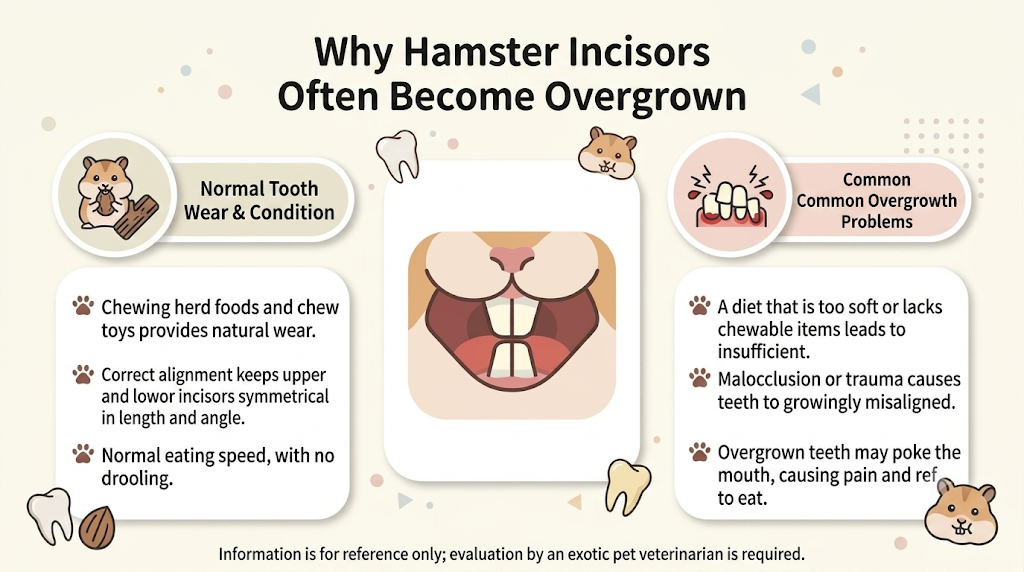
Hamsters belong to the rodent family, and their incisors grow throughout their entire lives. This physiological trait allows them to adapt to their needs for gnawing food and grinding teeth. The upper and lower incisors of a healthy hamster will maintain an appropriate length and angle, wearing down naturally through daily chewing.
If the diet is too soft, chewable objects are lacking, teeth alignment is abnormal, or if there is a history of injury or congenital malocclusion, the teeth may grow increasingly misaligned, or even pierce the oral cavity, gums, or lips, causing pain and difficulty eating.
Common Symptoms of Overgrown Hamster Teeth
Hamsters have small body sizes, and clinical signs can sometimes be subtle; owners should watch for the following situations:
- Slower eating speed;
- Food frequently dropping from the mouth;
- Only eating soft food or a reluctance to gnaw on hard food;
- Weight loss;
- Drooling or wet fur around the chin;
- Unusual odor around the mouth;
- Frequently pawing at the mouth with forelimbs;
- Incisors that are visibly overgrown, curved, or asymmetrical;
- Swelling on the face, chin, or below the eyes;
- Lethargy and decreased activity levels.
If a hamster suddenly stops eating, you cannot afford to wait too long. Because small animals have limited energy reserves, even a brief drop in appetite can rapidly compromise their health.
Does Cage Biting Mean the Hamster Has Overgrown Teeth?
Cage biting in hamsters does not necessarily mean their teeth are overgrown. It can be related to environmental stress, an overly small cage, lack of activity, boredom, tooth-grinding needs, or habit. However, if cage biting is concurrently accompanied by drooling, decreased appetite, abnormal incisor appearance, or weight loss, a dental or oral issue should be suspected.
Prolonged cage biting can also cause uneven force distribution on the teeth, leading to chipping, cracking, or deformation, which inversely increases the risk of oral injuries. Therefore, owners should not treat cage biting merely as a bad habit, but should simultaneously review the husbandry environment and the pet’s health status.
Common Causes of Overgrown Hamster Teeth
Lack of Appropriate Tooth-Grinding Objects
Hamsters require safe, appropriate gnawing objects to help grind their teeth. If suitable chewing supplies are lacking inside the cage, or if the diet is chronically soft, dental wear may be insufficient.
Malocclusion
Some hamsters have congenitally misaligned upper and lower teeth, or experience shifts in dental angles due to trauma, falls, or biting on hard objects. Malocclusion prevents teeth from grinding against each other normally, causing them to grow increasingly crooked.
Tooth Fractures or Trauma
A hamster’s teeth may fracture after falling, cage biting, or chewing on excessively hard objects. If the upper and lower teeth become imbalanced in length after a fracture, it can lead to subsequent malocclusion issues.
Age and Systemic Health Problems
Senior hamsters may experience compromised chewing and tooth-grinding due to reduced activity, dietary changes, or other illnesses. Dental issues can also occur concurrently with oral infections, abscesses, or other health conditions.
Professional Examination and Treatment Directions
The veterinarian will first evaluate the hamster’s body weight, mental state, hydration status, incisor length, dental angles, and the appearance of the lips and oral cavity. Because a hamster’s oral cavity is exceptionally tiny, a more detailed examination may be required if cheek teeth (molars), deep oral pathways, or abscess issues are suspected.
In the clinic, the veterinarian will utilize a professional otoscope to view the hamster’s narrow oral cavity, confirming whether lacerations or ulcers are present. Treatment typically involves professional “tooth trimming” (Trimming), where the veterinarian adjusts the teeth to an appropriate length using a micro-dental burr according to the specific case. If an infection has already occurred, it will be managed with antibiotics and anti-inflammatory painkillers.
In certain scenarios, the veterinarian may recommend diagnostic imaging to evaluate the tooth roots, facial swelling, or deep infections, and determine whether regular follow-up visits are necessary.
How to Prevent Overgrown Teeth Daily
Preventing overgrown teeth should begin with diet and the environment. Providing a high-quality pellet diet for hamsters supplemented with an appropriate amount of natural grains and hay is recommended. Safe tooth-grinding materials should be placed in the enclosure, such as natural apple wood sticks, mineral chew stones, sturdy cardboard tubes, or hamster-suitable wooden chews and gnawing toys. Enclosure space must be sufficient, equipped with a running wheel, hiding spots, and environmental enrichment to reduce cage biting triggered by stress or excessive boredom.
On a day-to-day basis, owners can routinely observe the hamster’s eating speed, body weight, and whether the fur around the mouth is wet. Regularly inspecting the color and length of the hamster’s teeth (healthy incisors typically present a dark yellow or orange hue rather than pure white) helps in taking action before issues deteriorate.
Warning Signs to Seek Medical Attention
If a hamster experiences inappetence, drooling, weight loss, an inability to close the mouth, facial swelling, bulging eyes, lethargy, or visibly overgrown incisors, a checkup with an exotic pet veterinarian should be arranged as soon as possible. Clinical conditions in hamsters can shift very rapidly; early management helps minimize pain and secondary complications.
Frequently Asked Questions
Is it normal for a hamster’s incisors to be yellow?
Healthy hamster incisors usually carry an orange-yellow tint, which is the normal color of their enamel. In a healthy adult hamster, the outer layer of the incisors contains iron, making an orange-yellow appearance a sign of normal and sturdy teeth. If a hamster’s teeth appear pale white, it may inversely indicate malnutrition, anemia, or illness. However, the tooth color of young pups is typically lighter and will gradually turn yellow as they mature.
Does cage biting mean a hamster definitely needs its teeth trimmed?
Not necessarily. Cage biting can be related to stress, environmental deficiencies, or tooth-grinding needs. A dental issue should only be strongly suspected if it is concurrently accompanied by drooling, decreased appetite, or abnormal dental appearance.
Can I clip my hamster’s teeth by myself?
Self-clipping teeth is absolutely not recommended for owners. A hamster’s teeth are tiny and fragile; utilizing inappropriate tools can cause tooth splitting, root damage, oral hemorrhage, or severe pain. Hamsters are also prone to injury from struggling due to panic. Correct management requires an understanding of tooth length, angle, occlusion, and oral status, which should be left to the evaluation of an experienced veterinarian.
Will overgrown hamster teeth wear down on their own?
Minor wear deficiencies can be resolved by improving the diet and tooth-grinding environment; however, if malocclusion has already manifested or overgrown teeth have pierced the oral cavity, veterinary intervention is typically required.
Will overgrown teeth recur after a hamster undergoes a tooth trim?
If the underlying cause is malocclusion or a congenital teeth alignment issue, it may still recur after a tooth trim, necessitating regular follow-up appointments. The veterinarian will arrange appropriate follow-ups based on the rate of dental growth.
CityVet Hamster Dental & Exotic Pet Clinic
CityVet is committed to providing outstanding comprehensive veterinary care, guided by the core values of professionalism, compassion, and trust. We aim to offer reasonable fees, introduce advanced equipment, and explain treatment options clearly to pet owners, so that every pet receives full medical support.
To book a hamster dental examination or exotic pet consultation, please call our Tsuen Wan branch at 2623 5500 or our Yuen Long branch at 2477 9990. Address: G/F, 186 Sha Tsui Road, Tsuen Wan / Shop 2, G/F, Fuk Shun Building, 25 Ping Wui Street, Yuen Long.
Disclaimer: This article is for general information only and does not replace professional medical diagnosis. If you have any concerns, please book a veterinary examination as soon as possible.