

Care Guide for Canine Cognitive Dysfunction Syndrome (Dog Dementia): Identifying Regression Warning Signs in Senior Dogs
Watching a beloved fur baby gradually grow old is a life stage that every owner must experience. In Hong Kong, with advancements in veterinary medical technology and nutritional science, the average life expectancy of dogs has extended significantly, making degenerative diseases in senior dogs increasingly prevalent. Among these, “Canine Cognitive Dysfunction Syndrome” (abbreviated as CDS, commonly known as dog dementia or canine Alzheimer’s) is a challenge that many owners are currently facing or will face in the future.
When a once-attentive, road-recognizing dog suddenly becomes disoriented or begins barking at midnight without reason, owners often feel helpless. Canine cognitive dysfunction is a brain degenerative disease highly similar to Alzheimer’s disease in humans. Understanding the early signs of this illness and intervening as early as possible through veterinary checkups is crucial for slowing down disease progression and enhancing the quality of life for senior dogs.
What is Canine Cognitive Dysfunction Syndrome?
Canine Cognitive Dysfunction Syndrome refers to a disease where brain functions are gradually lost due to age-related degeneration of brain tissue, beta-amyloid protein deposition, or obstruction of microcirculation in dogs. This degeneration directly impacts a dog’s cognition, memory, learning capacity, spatial awareness, and sleep-wake cycles.
Many owners easily mistake dementia symptoms for simple “signs of aging,” thereby missing the optimal window for control. Although this cerebral degeneration is an irreversible physiological process, we can effectively help fur babies maintain their current self-care abilities through early behavioral management, nutritional conditioning, and supportive medications.
Common Symptoms of Canine Cognitive Dysfunction Syndrome
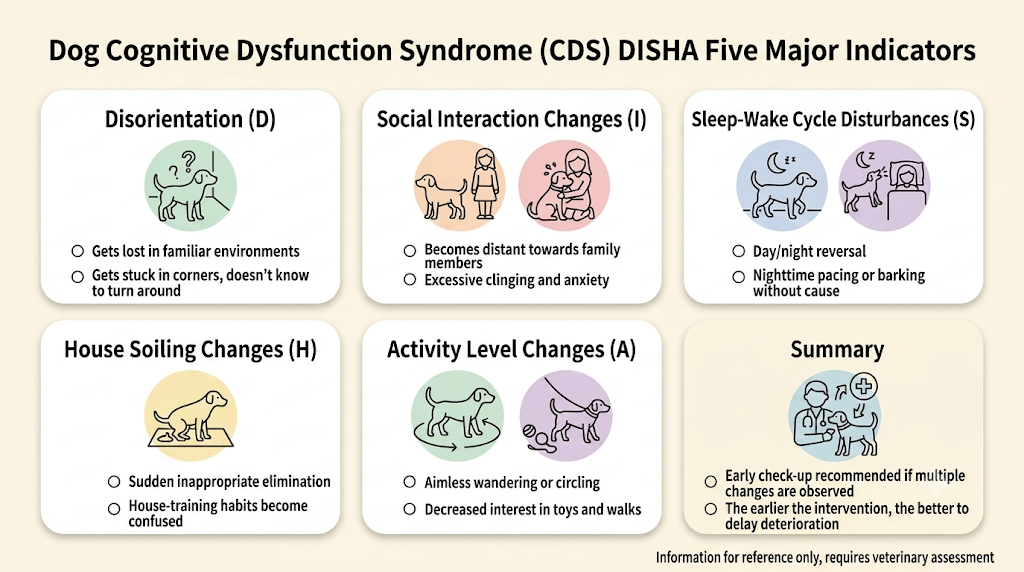
Clinically, veterinarians typically utilize the five major indicators of “DISHA” to evaluate whether a dog is suffering from cognitive dysfunction syndrome. If your senior dog at home exhibits multiple behavioral shifts listed below, a high level of alertness is recommended:
- Disorientation
Dogs may get lost in familiar environments. For instance, within a compact Hong Kong household, they might walk into a dead end between the sofa and the wall, then stand still helplessly, not knowing how to turn around and back out; or they might forget the location of the doorway and stare blankly at a wall.
- Changes in Social Interactions
Dogs that were originally warm and hospitable may become distant, no longer actively greeting their owners upon returning home from work, or even completely unresponsive to their owners’ petting. Conversely, some individuals may become overly dependent, experiencing intensified separation anxiety and needing to cling to their owners at all times.
- Sleep-Wake Cycle Disturbances
This is the symptom that causes the greatest distress to Hong Kong owners. The brain of an affected dog cannot correctly differentiate between day and night; they fall into deep sleep during the day, yet start pacing repeatedly inside the house at midnight, scratching the floor, or barking and whimpering without cause, severely disrupting the rest of owners and neighbors.
- House-Soiling and Changes in Habits
Dogs that were originally perfectly house-trained may suddenly begin to urinate or defecate in the center of the living room, on their sleeping mats, or in non-designated locations. This is not intentional misbehavior; rather, they have forgotten the house-training rules, or their brain has failed to receive elimination signals in a timely manner.
- Changes in Activity Levels
Dogs may exhibit aimless wandering, continuous circling, or even compulsive behaviors like licking their fur or chewing on objects. They also gradually lose interest in walks and toys they used to enjoy.
Why Do Senior Dogs Develop Dementia?
As age increases, neurons in a dog’s brain naturally atrophy and diminish. Scientific research has found that dogs with canine dementia frequently exhibit abnormal protein plaque depositions in their brains, which obstruct the transmission of nerve signals. Furthermore, senior dogs are prone to cerebral microvascular sclerosis, causing the brain to remain in a long-term state of mild hypoxia and nutrient deficiency, which accelerates cell death. Certain breeds or dogs that lack mental stimulation and social interaction over long periods may also undergo a relatively faster rate of regression.
How Do Veterinarians Diagnose Canine Cognitive Dysfunction?
Because many geriatric diseases (such as cataracts, degenerative arthritis, heart disease, or toxin accumulation caused by chronic renal failure) can cause dogs to exhibit similar neurological or behavioral abnormalities, the first step in diagnosing dog dementia is the “process of elimination.”
At CityVet, veterinarians perform comprehensive physical screening for senior dogs. Examination methods typically include:
- Detailed Clinical Consultation: Evaluating the daily behavioral changes recorded by the owner and the DISHA questionnaire.
- Blood and Urine Biochemistry Tests: Ruling out mental disorientation caused by internal organ failure, metabolic disorders, or endocrine imbalances.
- Neurological Examination: Testing the dog’s reflexes, vision, and hearing to differentiate whether the behavioral abnormalities are due to sensory decline or brain damage.
Treatment Directions and Medication Management to Delay Regression
Although contemporary medicine cannot guarantee a complete cure, veterinarians will formulate appropriate plans based on examination results, integrating a multi-pronged approach to delay the worsening of cognitive dysfunction:
- Prescribed Medications: Veterinarians may prescribe neurological drugs that help increase dopamine concentrations in the brain and improve cerebral microcirculation, which can effectively enhance a dog’s sense of orientation and reduce nighttime barking.
- Antioxidant Nutritional Supplements: Supplementing with healthcare products rich in Omega-3 fatty acids (EPA/DHA), Vitamin E, Vitamin C, Coenzyme Q10, and Phosphatidylserine (PS) helps combat free radicals in the brain and protect nerve cells.
- Prescription Diet Conditioning: Certain prescription diets specifically designed for senior dogs contain medium-chain triglycerides (MCTs), providing another highly efficient energy source for the degenerating brain.
Home Care and Daily Improvement Recommendations for Hong Kong Households
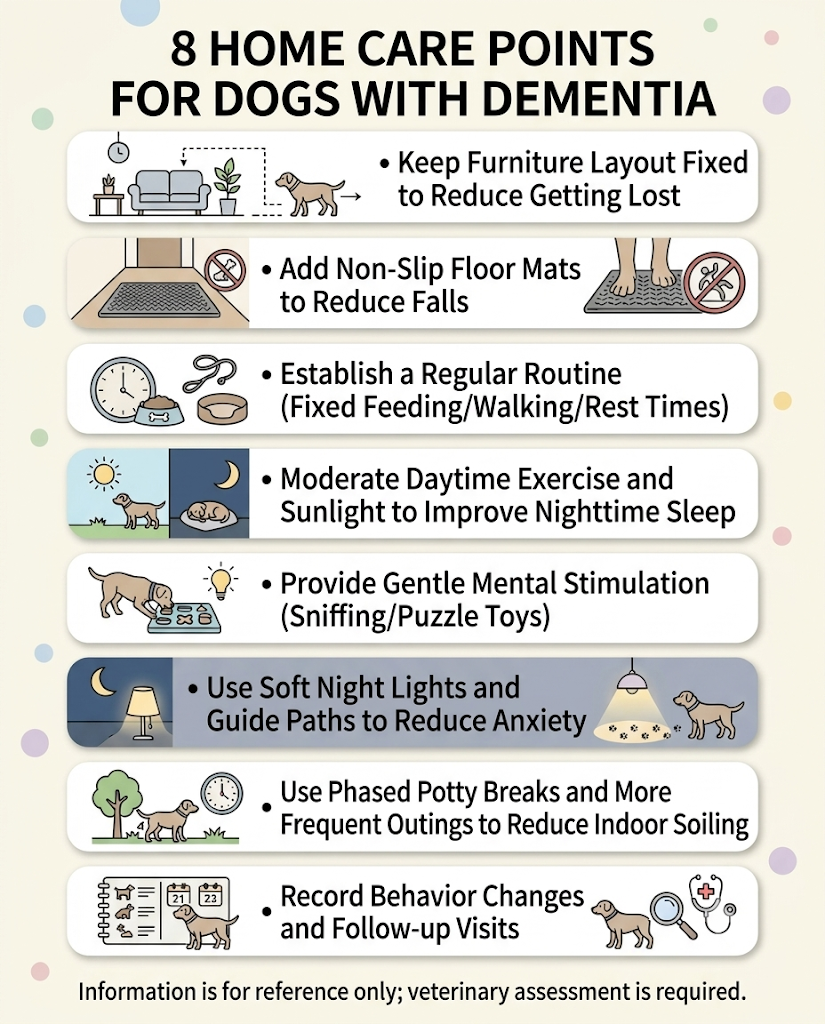
When facing a fur baby with dementia, creating a safe and low-stress environment can reduce their sense of anxiety:
When to Seek Veterinary Care for Senior Dogs?
When you discover that your dog is over 7 years old (large breeds) or 10 years old (small breeds) and their behavior suddenly becomes vastly different from before, or if the frequency of nighttime crying increases, you should schedule a veterinary checkup as early as possible. Never wait until the dog completely fails to recognize its owner or exhibits self-harming behaviors before seeking medical care. The earlier intervention management begins, the more ideal the efficacy of delaying cerebral regression tends to be, thereby securing more high-quality companionship time for the entire family.
Frequently Asked Questions
Is a dog barking continuously at midnight without reason suffering from dog dementia?
Barking at midnight is one of the classic manifestations of Canine Cognitive Dysfunction Syndrome, usually due to a disrupted circadian rhythm in the brain, or waking up in the middle of the night and experiencing internal panic triggered by disorientation. However, nighttime barking in senior dogs can also be caused by joint pain, bladder weakness requiring urination, or a lack of security resulting from a decline in hearing and vision. Owners should seek a comprehensive examination from a veterinarian to identify the true pain point or underlying cause before prescribing targeted management.
Can Canine Cognitive Dysfunction Syndrome be completely cured?
Current medical technology cannot “cure” or completely reverse the degenerative process of brain nerves. However, through early deployment of neuromodulating medications, specific antioxidant health supplements, and improvements to the home environment, veterinarians can effectively assist owners in slowing down the progression of the illness. Under proper care, many diagnosed dogs can still maintain a decent quality of life and basic self-care abilities.
How do you differentiate whether a dog is simply growing old, experiencing joint pain, or suffering from cognitive dysfunction?
Dogs that are simply growing old may only slow down in movement and have less stamina, but their responses to owners’ commands and interactions with family members typically remain unchanged. Dogs with joint pain will resist going up and down stairs and find standing up difficult, but they will not stare blankly into corners. In contrast, cognitive dysfunction is characterized by “cognitive and behavioral confusion,” such as failing to recognize familiar family members, circling without reason, or having a completely reversed sleep schedule. These two scenarios also frequently occur concurrently, requiring a detailed evaluation by a veterinarian.
Does playing with puzzle toys help prevent or delay dog dementia?
Highly helpful. The brain operates under the same “use it or lose it” principle as muscles. Before dogs step into old age or during the initial stages of dementia, letting them play more with snuffle mats and search for treats hidden in puzzle toys can effectively activate the neural networks of the brain, slowing the decline of cognitive capacities. Of course, the difficulty of the toys should progress gradually to avoid inducing a sense of frustration in senior dogs due to overly high difficulty.
Will a dog’s life expectancy shorten after being diagnosed with canine cognitive dysfunction?
Cognitive dysfunction syndrome itself is not a directly fatal illness. However, as the condition worsens, dogs may suffer from malnutrition or dehydration due to forgetting to eat or drink, or develop skin and urinary tract infections due to inappropriate elimination. Therefore, life expectancy often depends on the owner’s patient home care, environmental safety protections, and whether the dog can be regularly brought back to the clinic for a veterinarian to monitor internal organ functions.
CityVet Senior Dog Health Checks & Daily Care
CityVet is committed to providing outstanding comprehensive veterinary care, guided by the core values of professionalism, compassion, and trust. We aim to offer reasonable fees, introduce advanced equipment, and explain treatment options clearly to pet owners, so that every pet receives full medical support. To book a senior dog health screening or consult on dog dementia management protocols, please call our Tsuen Wan branch at 2623 5500 or our Yuen Long branch at 2477 9990. Address: G/F, 186 Sha Tsui Road, Tsuen Wan / Shop 2, G/F, Fuk Shun Building, 25 Ping Wui Street, Yuen Long.
Disclaimer
This article is for general information only and does not replace professional medical diagnosis. If you have any concerns, please book a veterinary examination as soon as possible.