Why are bearded dragon health problems so often linked to UVB and environmental management?
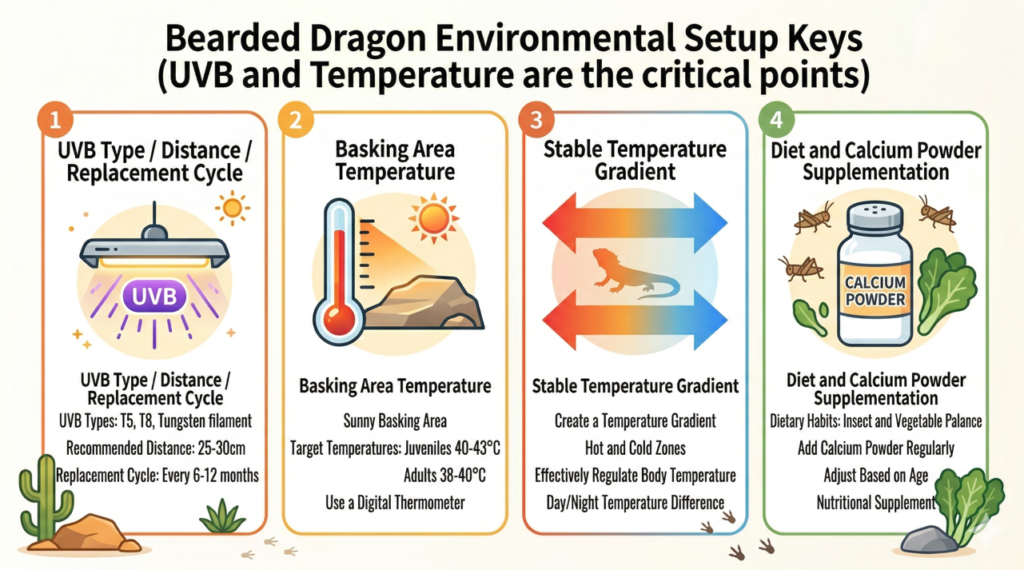
A bearded dragon’s health is closely tied to its husbandry environment, especially UVB exposure, basking area temperature, the overall temperature gradient, diet, and calcium supplementation. When these factors are unbalanced over time, the earliest signs may be reduced appetite, less activity, or lower alertness, and the problem can later progress to affect bone and metabolic health.
Common warning signs
Reduced appetite and lower activity levels
If a bearded dragon that usually eats well suddenly starts eating only a small amount, stops basking normally, or becomes clearly less active, owners should not assume it is simply “seasonal laziness.” Inappropriate husbandry, parasites, metabolic bone disease, or other systemic problems may all first present as changes in appetite and energy.
Weak limbs, tremors, and skeletal abnormalities
Metabolic bone disease can affect both skeletal and muscular function. If a bearded dragon develops weakness in the limbs, unstable movement, poorer grip strength, or visible abnormalities of the jaw or limbs, veterinary attention should be sought promptly. These cases often require both physical examination and imaging to clarify the cause.
Defecation, shedding, and parasite-related problems
If there are abnormalities in defecation, weight loss, or poorer skin condition, parasites should also be considered. Internal parasites can lead to weight loss, reduced appetite, diarrhoea, or constipation, while external parasites may cause skin problems.
Consultation checks and imaging assessment
A bearded dragon consultation usually begins with a review of the lighting equipment, UVB replacement schedule, basking area and cool-zone temperatures, substrate, diet, and calcium powder use. A clinical examination is then performed, and faecal tests, blood tests, or imaging may be recommended when needed to help identify the cause of the problem.
Key points for home management
A common issue in Hong Kong homes is not always the absence of equipment, but unstable settings. For example, the enclosure may have lighting, but the UVB intensity, distance, or exposure duration may be inappropriate, or the enclosure temperature may fluctuate too much in an air-conditioned room. Before the visit, it is helpful to photograph the full enclosure and lighting setup, and bring details of the enclosure settings (temperature / humidity / UVB), recent food intake, faecal output, weight changes, and shedding records to the clinic. This makes it easier to work out what is going on.
FAQ
Q1 | Does a bearded dragon that refuses food definitely have bone disease?
Not necessarily. The cause may also involve husbandry problems, parasites, stress, or other health issues.
Q2 | Does a bearded dragon need UVB?
Yes. Key elements of reptile care include UVB, temperature, humidity, and diet.
Q3 | What should I do if my bearded dragon has weak limbs?
If there is limb weakness or an abnormal gait, a veterinary consultation should be arranged as soon as possible.
Q4 | Will X-rays be taken during a bearded dragon consultation?
Imaging can be arranged when needed to evaluate the bones or other internal problems.
Q5 | What should I prepare before taking my bearded dragon to a vet in Hong Kong?
It is advisable to photograph the lighting setup and full enclosure beforehand, and provide the enclosure settings (temperature / humidity / UVB), recent food intake, faecal output, weight changes, and shedding records.
CityVet Bearded Dragon Clinic
CityVet is committed to providing outstanding comprehensive veterinary care. Guided by the core values of professionalism, compassion, and trust, we aim to offer fair pricing, advanced equipment, and clear explanations of treatment options, so that every pet receives thorough medical support.
Would you like to book a bearded dragon consultation? Please call our Tsuen Wan clinic at 2623 5500 or our Yuen Long clinic at 2477 9990. Address: G/F, 186 Sha Tsui Road, Tsuen Wan / Shop 2, G/F, Fook Shun Building, 25 Ping Wui Street, Yuen Long.
Disclaimer: This article provides general information only and cannot replace professional medical diagnosis. If you have any concerns, please book a veterinary examination as soon as possible.