

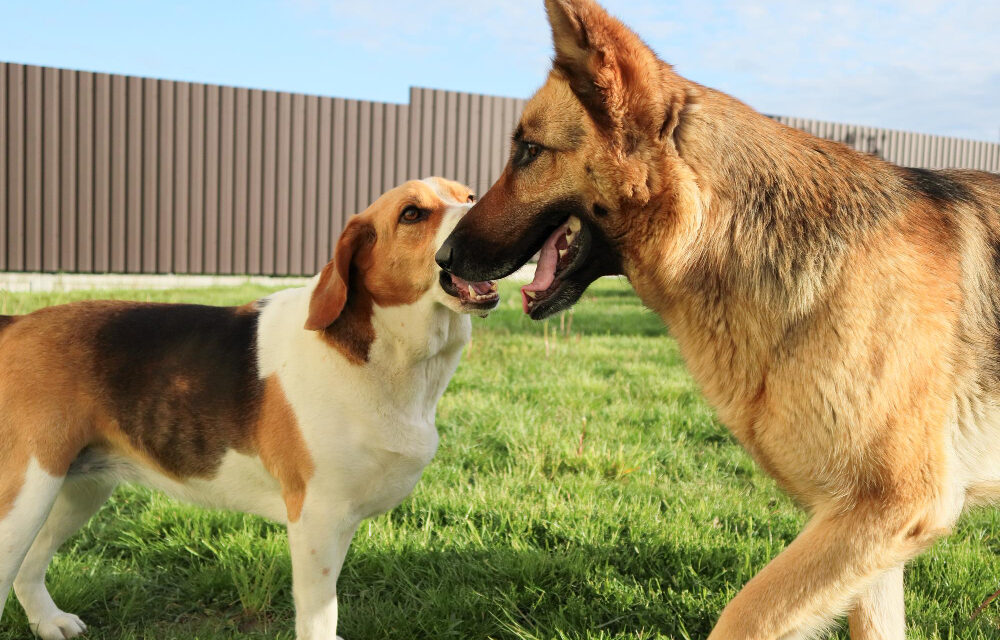
Walking your dog should be a relaxing activity, but for dog owners, going outdoors means paying attention not only to traffic, weather, and the environment but also to the state of other dogs nearby.
Especially in Hong Kong, many dog-walking routes pass through housing estate podiums, elevators, lobbies, narrow pavements, parks, and pet-inclusive spaces. When two dogs that don’t know each other suddenly meet in a confined space, conflicts can arise due to being startled, tension, pain, resource guarding, or simply not having enough space to retreat—even if both dogs are usually very docile.
Therefore, the most effective “method to handle a dog fight” is to prevent the conflict from ever reaching the point of an actual physical altercation.
Safety Preparations to Make Before Walking Your Dog
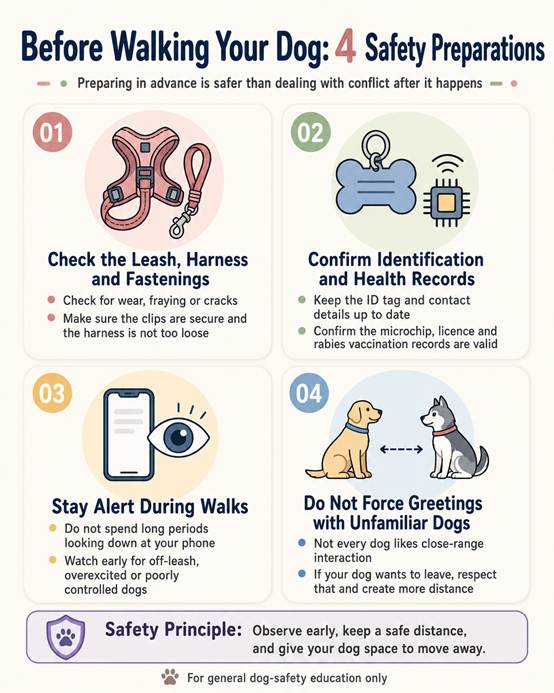
1. Check the Leash, Harness, and Hardware Before Every Walk
Don’t just confirm “I have the leash.” You should also check:
- Are there any frays or tears on the leash?
- Does the metal clasp lock properly and securely?
- Is the harness too loose? Will the dog “slip out” if they back away in fear?
- Is the collar too loose?
- Are the dog license tag and your contact information attached and complete?
If your dog is strong, choose walking gear that allows you to control them steadily. The Hong Kong Agriculture, Fisheries and Conservation Department (AFCD) stipulates that, under normal circumstances, “large dogs” weighing 20 kg or more must be held on a leash no longer than two meters in public places; this regulation also applies to public areas like building elevators, lobbies, and corridors.
2. Ensure Dog License, Microchip, and Rabies Vaccine are Valid
This is not only a vital part of responsible pet ownership but also crucial in the event of an accident, if your dog gets lost, or if identification is required. According to AFCD data, dogs over 5 months old must be licensed, which involves microchipping and rabies vaccination. Dog licenses and rabies vaccinations generally must be renewed every 3 years. Owners should also ensure the phone number and address registered to the microchip are up to date.
3. Don’t Constantly Look at Your Phone While Walking
Many dog conflicts can actually be avoided seconds or even much longer before they happen. For example, looking ahead, you might notice:
- A dog pulling hard on its leash.
- An owner clearly struggling to control their dog.
- An off-leash dog approaching you.
- Another dog staring intently at your dog.
- A dog standing at a corner, an elevator door, or a narrow chokepoint.
- Your own dog becoming tense or refusing to move forward.
If you are constantly looking down at your phone, it’s very easy to miss this crucial “conflict avoidance window.” Spotting another dog ten seconds earlier is far safer than trying to figure out how to separate two fighting dogs later.
4. Don’t Force Two Strange Dogs to “Say Hi”
Many owners naturally ask when they see another dog, “Does your dog bite?” or think, “Let them sniff each other, and they’ll be friends.” However, not every dog likes close contact with strange dogs. Even if a dog usually gets along well with others at the dog park, their reaction might be completely different when constrained by a leash, in a narrow space, in an unfamiliar environment, or if they are feeling unwell. If your dog clearly wants to avoid interaction, do not pull them back and force a nose-to-nose greeting. Allowing dogs to maintain distance is in itself a very important safety management technique. For dogs that are naturally anxious or reactive, veterinary behaviorists recommend reducing conflict risks by maintaining safe distances and choosing less stimulating times and locations for walks.
How to Tell If Another Dog Doesn’t Want to Interact?
Dogs won’t use words to tell us, “Please don’t come any closer.” They express stress, fear, and warnings through their body language. While walking, be on high alert if you see an approaching dog doing the following:
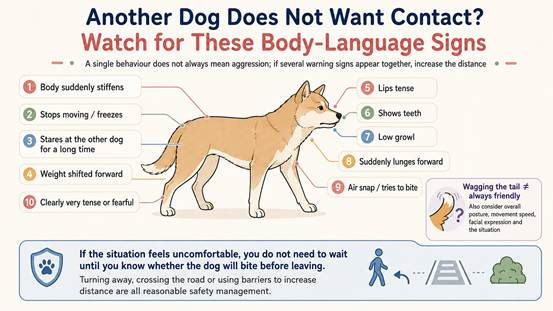
- Body suddenly becomes very stiff
- Stopping in their tracks, looking “frozen”
- Staring at your dog for a prolonged period
- Center of gravity noticeably leaning forward
- Tight, tense lips
- Baring teeth
- Growling
- Suddenly lunging forward
- Attempting to bite or air-snapping
- Showing obvious signs of intense stress or fear
However, a dog’s body language must be assessed in conjunction with the overall environment; you cannot determine a dog will definitely attack based on a single action. For instance, “wagging a tail” cannot simply be interpreted as “definitely friendly.” The American Veterinary Medical Association (AVMA) also reminds us that individual dogs express emotions differently; owners should observe the overall posture, behavior, and environment simultaneously, rather than relying on just one signal.
What to Do If Another Dog Stares Intently at Your Dog?
The simplest rule is: Do not wait to find out “if it will actually bite” before leaving. If you feel uncomfortable about the situation, directly create distance. For example:
- Cross to the other side of the street
- Turn into another street
- Turn around and walk away
- Stand behind a parked car
- Use a pillar, fence, or other obstacles to block their line of sight
- Let the other dog pass first
This is not being “timid.” In canine behavior management, proactively increasing distance is a highly important preventative measure. The American College of Veterinary Behaviorists (ACVB) also suggests using environmental barriers like parked cars or trees to reduce direct contact when a dog is easily stimulated by others.
What to Do If Another Dog Suddenly Rushes or Charges at Your Dog?
This is the scenario dog owners fear most. Especially when the other dog:
- Is off-leash
- Has an owner who is far away
- Cannot be recalled by its owner
- Is charging in a fast, straight line toward your dog
- Has a stiff body and a fixed stare
- Has already started barking, growling, or lunging
At this moment, your priority is not to “teach the other dog a lesson,” but to: Prevent the two dogs from getting close enough to bite each other.
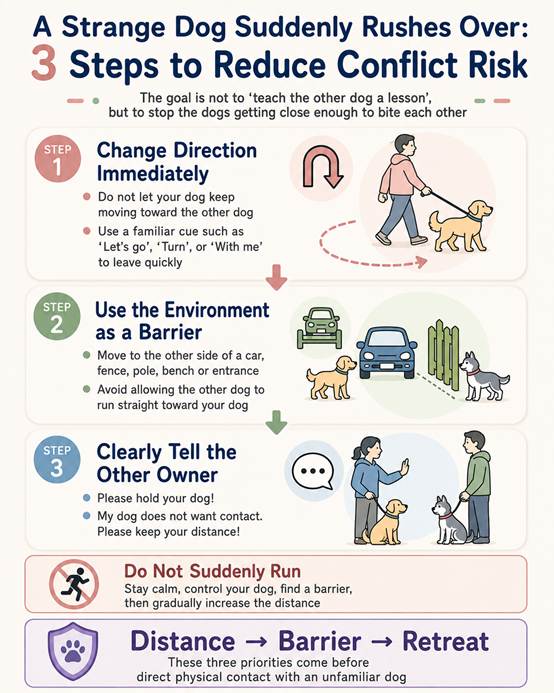
Step 1: Don’t Let Your Dog Advance
If there is still distance between them, change direction immediately. You can train your dog to be familiar with simple daily cues, such as:
- “Let’s go”
- “Turn”
- “With me”
- “Come”
In a real emergency, a well-practiced, rapid U-turn is often much more effective than frantically pulling on the leash.
Step 2: Use the Environment to Create Physical Barriers
Look for nearby objects such as:
- Parked cars
- Fences
- Gates
- Pillars
- Benches
- Trash cans
- Building entrances
Use these objects to create space between the two dogs. For example, instead of standing in the middle of the path waiting for the other dog to run over, guide your dog to the other side of a vehicle. The goal is to prevent the other dog from making a direct, straight-line charge at your dog.
Step 3: Communicate Clearly to the Other Owner
Don’t be afraid to speak up. State clearly and directly:
- “Excuse me, please leash your dog!”
- “My dog doesn’t want to interact, please keep your distance!”
- “Please put a leash on your dog!”
Do not let the dogs interact just because the other owner says, “Don’t worry, he doesn’t bite.” You know your dog’s condition best, and refusing contact is completely reasonable.
Should You Run Away If an Off-Leash Dog is Charging?
Generally speaking, do not suddenly turn and sprint away with your dog. Running fast can make the entire situation more highly charged, and an owner is prone to falling or losing control of their own dog while running in a panic. If you feel threatened by a strange dog, the AVMA recommends staying calm, avoiding screaming or sudden running, and slowly creating distance when safe to do so. A more practical approach is:
- Control your own dog;
- Immediately find a barrier;
- Change direction;
- Create distance from the other dog;
- Demand the other owner recall and control their dog.
Small Dog Owners: Should You Immediately Pick Up Your Dog?
This question doesn’t have a simple “always pick them up” or “never pick them up” answer.
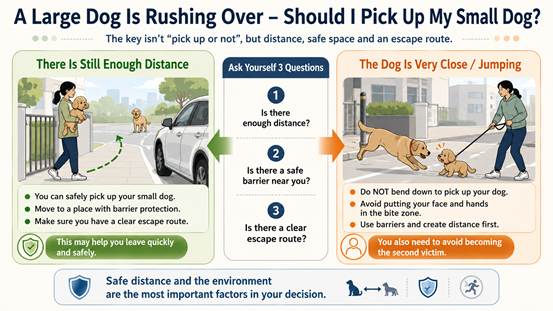
If the other dog is still a fair distance away and you can safely pick up your small dog and immediately move behind a gate, vehicle, fence, or other barrier, picking them up may help you evacuate quickly.
But if the other dog is already very close, jumping, lunging, or within striking distance: Do not hastily bend down and put your face and hands between the two dogs.
Doing so may result in:
- Your hands getting bitten by the approaching dog
- Being knocked over by the jumping dog
- Your face entering the dog’s bite zone
- Being accidentally bitten by your own dog in the chaos
- The other dog continuing to jump and lunge at you after you pick up your dog
The key is not “whether to pick them up,” but whether you still have enough distance, a safe space, and a clear retreat route.
Can You Pull Your Dog Behind You?
If there is still distance between the dogs, you can keep your dog close and guide them to a safe spot. However, do not intentionally place your own body directly in front of a dog that is already actively biting, just to “protect your dog.” Owners need to protect their pets, but they must also avoid becoming a second casualty.
Should You Yell, Kick, or Push the Other Dog Away?
If the conflict has not yet occurred, the first choices are always: Distance, retreat, and barriers. Do not immediately charge at the strange dog, push it with your hands, or initiate physical contact, as this may redirect the dog’s aggression toward you. Especially when a dog is highly aroused, they may experience “redirected aggression”—meaning the dog’s original target was the other dog, but the person intervening gets bitten instead. Veterinary behaviorists specifically warn of the risk of redirected bites when people directly intervene in dog fights.
What to Do If the Two Dogs Are Actively Fighting?
This is the most dangerous phase. Many owners’ first reaction is: “Reach in and grab my dog immediately!” However, this is exactly when owners are most likely to sustain severe bite injuries.
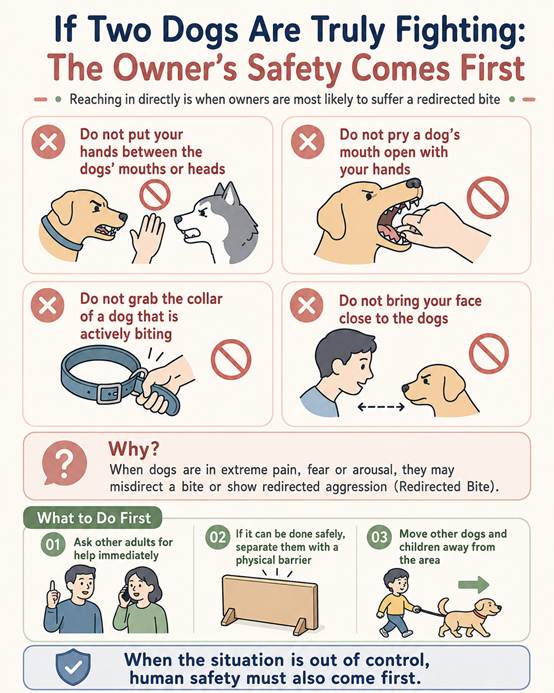
Do not put your hands near the dogs’ mouths or heads. Also, do not attempt to:
- Pry a dog’s mouth open with your hands
- Grab the collar of a dog that is actively biting
- Put your face near the dogs
- Pull the dogs apart by grabbing between their heads
Even if your dog has never bitten you, they may accidentally bite or redirect their aggression under extreme pain, fear, and arousal. Behavioral literature notes that directly reaching for fighting dogs can result in injuries to the person intervening.
Prioritize Finding Help and Creating Safe Barriers If you can separate the dogs using a physical barrier without putting your body into the bite zone, it is much safer than intervening bare-handed. In public places, you should immediately:
- Demand the other owner control their dog
- Ask nearby adults to help clear the area
- Move other dogs and children away from the scene
When a situation spirals out of control, human safety must also be the top priority.
After Separating the Dogs: Do Not Force Them to “Make Up”
Even if the two dogs have stopped biting: Do not bring them back face-to-face. After a fight, both dogs may still be in a state of high arousal and tension. Approaching each other again could quickly trigger a second round of attacks. You should:
- Take the two dogs to separate locations out of each other’s sight;
- Ensure leashes and walking gear are secure;
- Let the environment calm down;
- Check yourself and your dog for injuries;
- If there are bite wounds, contact a veterinarian.
Even If You “Don’t See Wounds,” Check Carefully
After a fight, owners often only check, “Is there any bleeding?” However, fur can completely hide small puncture wounds. When it is safe, carefully examine the:
- Neck
- Chest
- Abdomen
- Front and hind limbs
- Armpits
- Ears
- Face
Also, watch if your dog exhibits:
- Rapid breathing
- Reluctance to move
- Limping
- Abnormal quietness
- Trembling
- Obvious pain
- Pale gums
- Swollen abdomen
- Continuous panting
- Weakness or collapse
Especially if a small dog was bitten, pinned, or shaken by a large dog, immediate veterinary assessment is highly recommended even if you cannot find large wounds on the skin’s surface.
Don’t Assume They Are Fine Just Because They Are Still Walking
Adrenaline and a state of high tension can allow animals to remain active in the early stages of an injury. Therefore, “still walking, still eating, not crying” does not completely rule out severe trauma. If you confirm your dog was genuinely bitten by another dog—especially involving the chest, abdomen, neck, or an attack with a significant size disparity—the safest approach is to consult a vet.
Train an “Emergency U-Turn” Cue in Daily Life
This is a highly practical dog-walking skill. When there are no other dogs around, practice the following: The owner says a specific cue, such as “Let’s go!” and immediately turns 180 degrees. The dog follows the owner away, and receives a reward upon success. Gradually help the dog establish the habit: “Hearing this word = immediately turn and leave with my owner.” When a strange dog suddenly appears, this type of well-practiced behavior is usually much easier to control than suddenly yanking hard on the leash.
10 Things to Avoid When Walking Your Dog
Think of the following as a simple safety checklist for outings:
- Do not walk while looking down at your phone for long periods.
- Do not let the leash get so long that your dog can suddenly dash into the road or toward other dogs.
- Do not force strange dogs to interact with each other.
- Do not ignore your dog’s unease just because the other owner says “he’s friendly.”
- Do not let two dogs suddenly meet face-to-face at elevator doors or narrow corners.
- Do not let a child independently walk a dog whose strength far exceeds theirs.
- Do proactively increase distance when you see another dog is clearly tense.
- Do not continue approaching a source of stimulation when your own dog starts getting scared or agitated.
- Do not stick your hands between the heads of two dogs that are actively fighting.
- Do carefully observe your dog and seek veterinary care as needed after a fight, even if there are no apparent large wounds.
If Your Dog is Prone to Barking or Lunging at Others, Proactively Manage It
The recent news has made many small dog owners fearful of large dogs, but canine safety shouldn’t be simplified to “large dogs dangerous, small dogs safe.” Any dog can bite when experiencing fear, pain, a threat, or severe stress. The AVMA explicitly states that it is inappropriate to predict a dog’s aggression based solely on breed.
If your dog has a history of:
- Biting other dogs
- Repeatedly lunging at other dogs
- Losing control completely upon seeing another dog
- Showing obvious aggressive reactions toward people or dogs
- Sudden behavioral changes
Owners shouldn’t just think, “He’s just a bit fierce.” Pain and certain health issues can also affect a dog’s behavior. It’s best to have a veterinary check-up first, and then seek help from a canine behavior professional. For dogs with a known bite risk, veterinary behaviorists may recommend appropriate muzzle training (e.g., using a well-fitted basket muzzle) combined with environmental management and behavioral training, rather than relying solely on the muzzle to solve the problem.
The Most Important Phrase to Remember: “Leave Earlier”
Many dog conflicts don’t go from “zero to one hundred” out of nowhere. The most useful safety habit is to: See it earlier, judge it earlier, and create distance earlier.
If you see a dog ahead that makes you feel uneasy, there is no need to wait and wonder, “Do they want to play, or do they really want to bite?” before making a decision. Turning around, crossing the street, and keeping your distance are often the most effective forms of prevention.
If your dog is actually bitten, especially a small dog attacked by a larger dog, do not rely solely on the surface wound’s size to decide whether to seek medical attention. If your dog was just attacked, bitten, or violently struck by another dog, contact CityVet as soon as possible and inform the vet of:
- The time of the incident
- Location of the bite
- Approximate size of the other dog
- Whether your dog was pinned or shaken
- Whether there is bleeding
- Your dog’s current mental state
- Any abnormalities in breathing
Our vets will assess the situation and advise whether an immediate examination is necessary.
CityVet Dog Outpatient & Check-up Services CityVet is dedicated to providing excellent and comprehensive veterinary medical services. Upholding our core values of “Professionalism, Care, and Trust” with a commitment to reasonable pricing, we utilize advanced equipment and explain all treatment methods in detail to owners, ensuring complete medical care for every pet.
Looking to book an outpatient consultation or check-up for your dog? Please call our Tsuen Wan Clinic at 2623 5500 or Yuen Long Clinic at 2477 9990. Addresses: G/F, 186 Sha Tsui Road, Tsuen Wan / Shop 2, G/F, Fook Shun Building, 25 Ping Wui Street, Yuen Long.
Disclaimer: This article provides general information only and cannot replace professional medical diagnosis. If you have any concerns regarding your pet’s health, please book a veterinary check-up as soon as possible.