
Is Loud Breathing or Open-Mouthed Breathing Normal in Parrots? Identifying Health Warning Signs of Avian Respiratory Diseases
In Hong Kong, parrots are highly popular family pets; they are intelligent, lively, and exceptionally social. However, the physiological structure of birds is very unique, particularly their highly evolved respiratory system. Unlike mammals, parrots possess a complex system of “air sacs.” While this allows them to perform gas exchange with high efficiency, it simultaneously renders them extremely sensitive to airborne toxins, bacteria, and molds.
When an owner notices their parrot experiencing louder breathing, frequent open-mouthed breathing, or even their tail bobbing drastically in tandem with their breath while at rest, this is often not simple fatigue, but a warning sign that the respiratory system is under severe threat. Due to the natural instinct of birds to mask clinical signs, once symptoms become apparent, the condition has usually developed to an advanced stage, making timely veterinary examinations crucial.
Why Are Parrot Respiratory Tracts So Fragile?
To understand respiratory diseases in parrots, one must first understand their “air sacs.” A bird’s lungs are relatively fixed, and air movement is primarily driven like a bellows by multiple air sacs distributed throughout the thoracic and abdominal cavities. Although this structure supports the high metabolic rate required for flight, the walls of the air sacs are incredibly thin and have sparse vascular distribution. Once pathogens enter, it is difficult for the immune system to establish a line of defense within the air sacs, easily leading to the spread of infection.
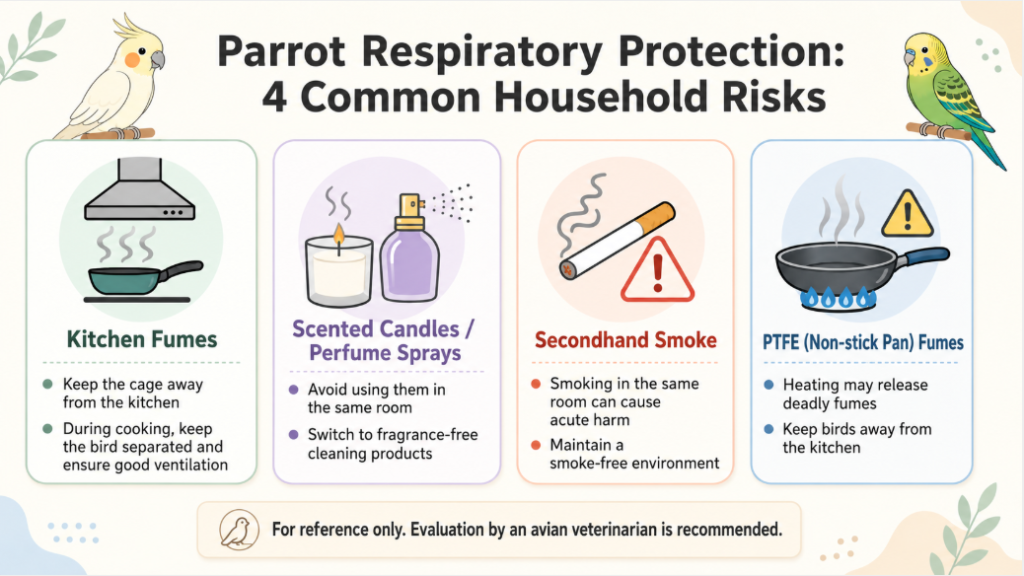
Furthermore, common household hazards in Hong Kong such as kitchen oil fumes, scented candles, secondhand smoke, and even gases generated by heated Teflon (non-stick) cookware can be fatal to parrots.
Common Signs of Parrot Respiratory Diseases
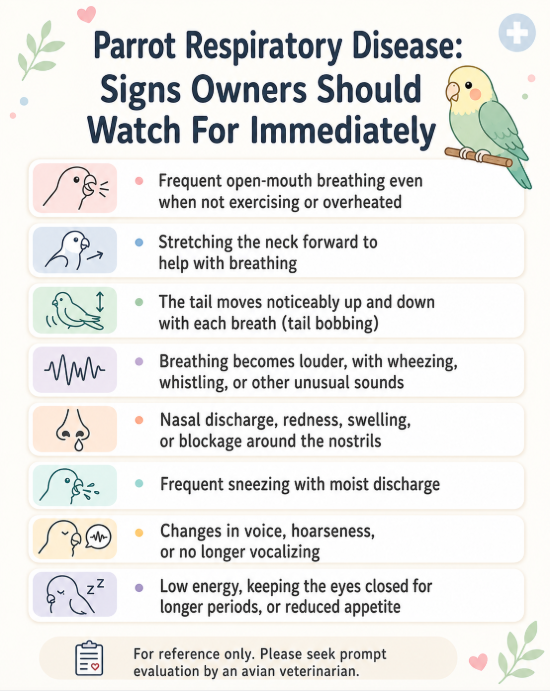
As owners, it is essential to learn to distinguish between normal heavy breathing and pathological dyspnea (respiratory distress). The following are typical manifestations when a parrot encounters respiratory system issues:
- Open-Mouthed Breathing and Neck Extension
If a parrot frequently opens its beak to breathe outside of strenuous exercise or a high-temperature environment, accompanied by a forward neck-stretching motion, it indicates they are struggling to acquire more oxygen.
- Tail Bobbing
This is one of the most direct visual methods to evaluate respiratory distress in birds. When a parrot finds it difficult to breathe, it must employ abdominal muscles to assist air sac function, causing the tail to bob up and down significantly in rhythm with their breathing frequency.
- Abnormal Breathing Sounds and Murmurs
Normal parrot breathing should be quiet and silent. If you hear clicking sounds, wheezing/whistling tones, or heavy panting, it typically indicates mucus accumulation or narrowing within the trachea or bronchi.
- Nares Changes and Sneezing
Observe the parrot’s nares (nostrils) for discharge, redness, swelling, or blockages. An occasional sneeze or two might simply be clearing out dust, but frequent sneezing accompanied by wet discharge is an indication of infection.
- Vocal Changes
If a parrot suddenly stops talking, its calls become hoarse, or its pitch changes, this may imply that the syrinx (the vocal organ at the bifurcation of the trachea) is infected or under pressure.
Common Causes of Respiratory Tract Diseases
- Bacterial and Viral Infections: Such as Chlamydia psittaci (Psittacosis/Parrot Fever). This not only affects avian health but is also a zoonotic disease (can be transmitted to humans), requiring extra caution.
- Fungal Infections (Aspergillosis): Under Hong Kong’s humid climate, improperly stored seed diets or damp bedding can easily harbor mold spores. Once a parrot inhales these spores, fungal plaques can easily form within the air sacs, resulting in chronic respiratory distress.
- Environmental Irritants: Strongly scented detergents, perfumes, aerosol sprays, etc., can all irritate or scorch the delicate respiratory mucosa of birds.
- Malnutrition: Vitamin A deficiency leads to squamous metaplasia (keratinization) of the respiratory mucosal epithelial cells, reducing their defensive capabilities and making them more susceptible to pathogen invasion.
Home Care and Preventive Measures
Maintaining optimal environmental quality is the primary task in preventing avian respiratory diseases:
- Maintain Air Circulation: Ensure the cage environment is well-ventilated, but avoid direct airflow from air conditioning vents.
- Control Humidity and Hygiene: Clean the cage and perches regularly, and prevent bedding from becoming damp and breeding mold.
- Keep Away from the Kitchen: It is strictly forbidden to house parrots near the kitchen to avoid oil fumes and non-stick cookware toxicity.
- Balanced Diet: Aside from seeds, a rich variety of vegetables and appropriate amounts of fruit should be provided to ensure sufficient Vitamin A intake.
When to Seek Immediate Veterinary Examination?
Because respiratory diseases in birds deteriorate with extreme rapidity, if you notice your parrot spending more time with its eyes closed, displaying a decreased appetite, fluffed-up feathers, and presenting with the aforementioned respiratory symptoms, please contact a veterinarian experienced in avian medicine immediately. The veterinarian will evaluate lung and air sac conditions via auscultation and radiography (X-ray), or perform nasal swabs/smears for diagnostic tests to formulate an appropriate antibiotic or antifungal treatment plan.
Frequently Asked Questions
Is it normal for a parrot to breathe with an open mouth after flying?
After vigorous flight or being startled, a brief period of open-mouthed breathing is a normal physiological response due to accelerated metabolism. However, a healthy parrot should resume steady breathing within 1-2 minutes after stopping exertion. If it requires a long time to recover, or breathes with an open mouth even while at rest, it indicates potential underlying issues with cardiopulmonary function.
Why is tail bobbing considered a dangerous signal?
Birds do not have a diaphragm; they rely on the contraction of thoracic and abdominal muscles to drive the air sacs for respiration. When the respiratory tract is obstructed or lung function is compromised, the parrot must forcefully contract its abdominal muscles to increase air intake. This force is transmitted to the tail, forming a distinct up-and-down bobbing motion. This typically indicates that the bird is already in respiratory distress, expending massive amounts of physical energy.
Are scented candles or perfumes really harmful to parrots?
Yes, they are highly toxic. The respiratory system of birds is extremely sensitive to chemical molecules in the air. Essential oil components released by scented candles, artificial fragrances, and microscopic particles generated by combustion can all cause acute allergic pneumonia or respiratory mucosal damage in parrots. For the health of your beloved bird, the environment should be kept as odor-free as possible.
Can a parrot’s cold resolve on its own?
Parrots do not have what humans refer to as a “common cold.” Once respiratory symptoms manifest, it is usually a bacterial, fungal, or viral infection. Because avian metabolism is incredibly fast, minor symptoms can evolve into severe systemic infections within just 24-48 hours. Therefore, self-monitoring or self-medication is not recommended; an early diagnosis by a veterinarian is the safest approach.
CityVet Avian Clinic & Internal Medicine Consultation
CityVet is committed to providing outstanding comprehensive veterinary care, guided by the core values of professionalism, compassion, and trust. We aim to offer reasonable fees, introduce advanced equipment, and explain treatment options clearly to pet owners, so that every pet receives full medical support. To book an avian respiratory examination or professional avian consultation, please call our Tsuen Wan branch at 2623 5500 or our Yuen Long branch at 2477 9990. Address: G/F, 186 Sha Tsui Road, Tsuen Wan / Shop 2, G/F, Fuk Shun Building, 25 Ping Wui Street, Yuen Long.
Disclaimer: This article is for general information only and does not replace professional medical diagnosis. If you have any concerns, please book a veterinary examination as soon as possible.