
Many owners of rabbits, guinea pigs or hamsters have heard that these pets need to wear down their teeth. But do you know why their teeth grow throughout life? If insufficient tooth wear leads to overgrowth or malocclusion, how serious can the health consequences be? In fact, oral and dental problems are among the most common reasons for veterinary visits in herbivorous and rodent small pets. This article explains their dental anatomy, complications caused by overgrown teeth and veterinary dental treatment.
A Remarkable Anatomy: Open-Rooted Teeth (Aradicular Hypsodont)
The dental structure of rabbits, guinea pigs and hamsters is very different from that of humans, cats and dogs:
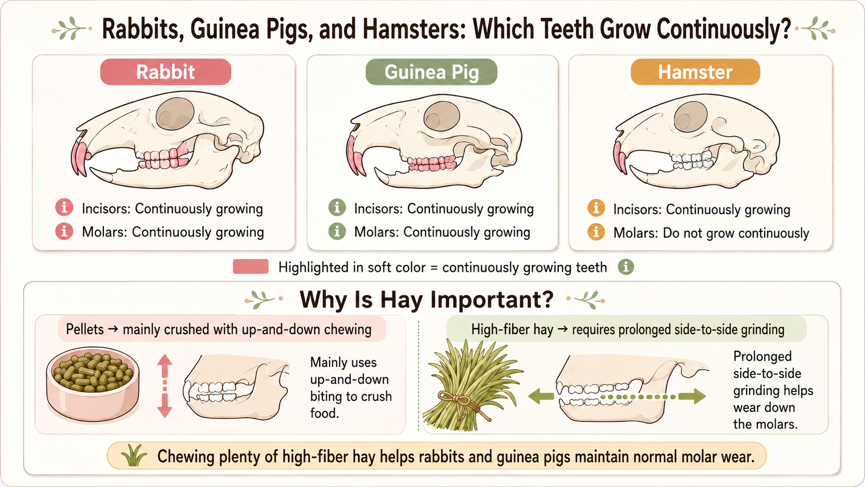
- Rabbits and guinea pigs: They have open-rooted teeth; all teeth, including incisors and deep cheek teeth, continue to grow throughout life at about 1 cm per month.
- Hamsters: Only the upper and lower pairs of front incisors continue to grow throughout life; the back molars do not.
In nature, these animals chew large amounts of coarse fiber, such as fibrous bark and hay, allowing the upper and lower teeth to grind against each other and maintain a dynamic balance between growth and wear.
Causes of Insufficient Tooth Wear and Overgrown Teeth
- Inappropriate diet structure (the main cause): Long-term feeding of refined pellets and high-calorie treats, with insufficient high-fiber hay such as Timothy hay. Pellets only require up-and-down crushing, while hay requires side-to-side grinding, which is the key movement for wearing down cheek teeth.
- Congenital malocclusion: Abnormal jaw structure or genetic defects may prevent the upper and lower jaws from aligning correctly.
- Trauma or missing teeth: Previous impact may fracture a tooth, allowing the opposite tooth to overgrow because it has lost its contact surface.
Serious Complications Caused by Overgrown Teeth
When teeth cannot wear down normally, overgrowth can trigger a chain of disease problems:
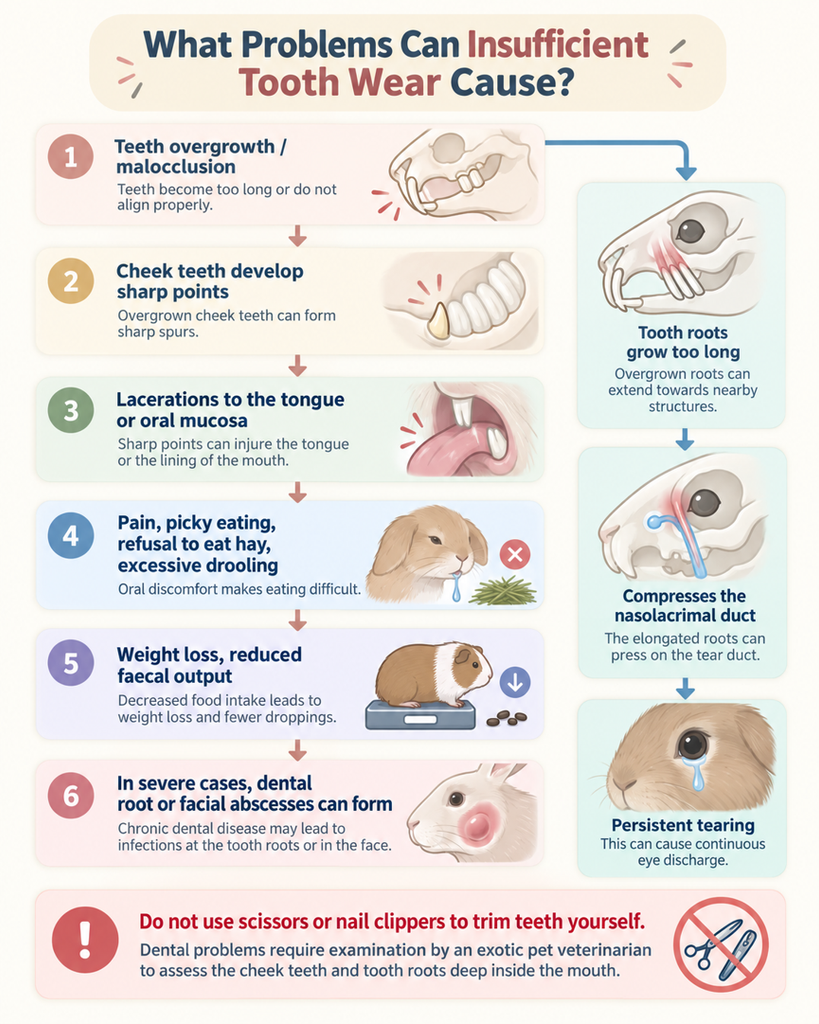
- Tongue and mucosal injury and pain: Overgrown lower cheek teeth may curve inward and stab the tongue; upper cheek teeth may grow outward and puncture the cheek mucosa, causing severe oral ulcers and painful loss of appetite.
- Facial and apical abscesses: When the crown cannot wear down properly, the root may grow backward into the jawbone. Bacteria can track deep along the tooth root and form serious bony abscesses in the cheek, chin or under the eye socket.
- Nasolacrimal duct obstruction: Overgrown roots of upper incisors or premolars can compress the tear duct, causing frequent tearing and conjunctivitis.
How to Recognize Dental Warning Signs in Small Pets
- Reduced appetite or selective eating, such as eating only soft foods or refusing hay.
- Persistently wet fur under the chin from drooling, or a bad odor from the mouth.
- Watery eyes, or a firm swelling under the eye socket or on the chin.
- Rapid weight loss, reduced stool volume and smaller fecal pellets.
Professional Veterinary Dental Treatment
Once teeth are overgrown or malocclusion is present, eating hay alone cannot solve the problem. An exotic pet veterinarian must treat it:
- Otoscope and oral speculum examination: Specialized instruments are used to carefully examine the deep cheek teeth.
- High-resolution X-rays: X-rays assess the hidden tooth roots inside the jawbone and check for bone destruction.
- Gas anesthesia and professional dental trimming/filing: Under general anesthesia, a specialized miniature dental burr, not nail clippers, is used to file overgrown teeth or sharp spurs down to the correct physiological height.
- Abscess debridement surgery: If an apical abscess has formed, surgical drainage and long-term antibiotics may be needed.
Frequently Asked Questions (FAQ)
Q: Can I trim a rabbit’s or guinea pig’s incisors with human nail clippers?
A: Absolutely not. Using scissors or nail clippers creates shearing force that can easily split the tooth vertically down to the root, causing severe pain and serious apical infection and abscessation.
Q: Are dental biscuits or chew blocks enough to wear down the teeth of hamsters or rabbits?
A: No. Chew blocks only affect the front incisors and do not help the deep cheek teeth, where the most serious problems often occur. Only extensive chewing of high-fiber hay effectively wears down cheek teeth.
Q: After rabbit tooth trimming, will regular trimming always be needed?
A: If early overgrowth was caused by diet, switching to a high-hay diet may restore normal wear. However, congenital skeletal malocclusion usually requires veterinary dental filing every 4 to 8 weeks.
Q: Does drooling and a wet chin in guinea pigs mean dental problems?
A: Yes. When overgrown cheek teeth injure the tongue or mouth, guinea pigs may be unable to swallow saliva because of severe pain, causing the chin and chest fur to remain wet, a condition often called slobbers.
Q: What should I do if my hamster breaks one incisor?
A: Take it to the clinic for examination. The broken incisor will regrow, but during this period the opposite normal incisor loses its grinding partner and may overgrow and injure the mouth. Veterinary monitoring or preventive trimming may be needed.
CityVet Rabbit and Rodent Consultation
CityVet is committed to delivering excellent, comprehensive veterinary medical services. Guided by the core values of professionalism, care and trust, we provide reasonable fees, introduce advanced equipment, and explain treatment options clearly to pet owners, offering comprehensive medical care for every pet. Want to book a rabbit and rodent dental consultation? Please call our Tsuen Wan clinic at 2623 5500 or our Yuen Long clinic at 2477 9990. Address: G/F, 186 Sha Tsui Road, Tsuen Wan / Shop 2, G/F, Fook Shun House, 25 Ping Wui Street, Yuen Long.
Disclaimer: This article provides general information only and cannot replace professional medical diagnosis. If you have any concerns, please book a veterinary consultation as soon as possible.