

Has your active parrot suddenly developed a one-sided drooping wing, is unable to fold the wing properly, or is completely unwilling to fly or flap? This is a common bone and muscle emergency in avian practice. Bird bones are adapted for flight and contain air spaces; their bone walls are very thin and fragile, making fractures possible after impact. At the same time, tendons and ligaments around the wing may also be strained or sprained, causing soft tissue injury. When a parrot’s wing looks abnormal, how can owners make an initial assessment, and how should the bird be safely taken to the vet?
Why Would a Parrot’s Wing Suddenly Droop?
A bird’s wing is a precise and complex structure supported by the humerus, ulna, radius, metacarpal bones and multiple muscle and ligament groups. Common causes of drooping wings and refusal to fly include:
- Household impact injuries: During indoor flight, a frightened bird may crash into a glass window, wall or furniture.
- Accidental crushing or trapping: The wing may be caught in a door gap, or the bird may be accidentally pressed on a bed or sofa.
- Getting caught in the cage: Wing feathers or leg rings may snag on toy strings or cage gaps, causing strain or fracture when the bird panics and struggles.
- Joint dislocation or ligament tear: Forceful pulling can dislocate the shoulder or elbow joint.
Fracture vs Soft Tissue Injury: Comparing the Signs
Accurate diagnosis must rely on an avian veterinarian, but owners can make an initial observation based on the following signs:
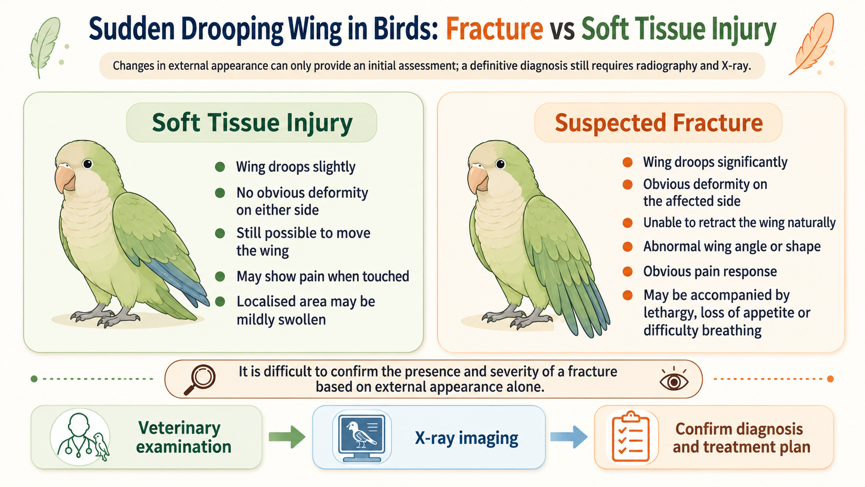
Soft tissue injury (tendon strain or contusion)
- Appearance: The wing may droop slightly, but the symmetry of both wings is not completely disrupted.
- Range of movement: The parrot may still be able to tuck the wing in slightly, but will stop when attempting to flap because of pain.
- Feel and swelling: Mild local redness or swelling may be present, but there is no obvious grinding sensation from broken bone or severe deformity.
Fracture
- Appearance: One wing is severely drooped, sometimes dragging on the floor, and cannot naturally return to the side of the body.
- Deformity and bleeding: The wing angle may be abnormally twisted. With an open fracture, the broken bone may even penetrate the skin and be accompanied by bleeding.
- Pain response: The parrot may become extremely depressed, breathe rapidly, tremble, scream when touched or attempt to bite.
Professional Diagnosis and Treatment by an Avian Veterinarian
Bird physiology is highly sensitive. After injury, pain and shock can quickly become life-threatening, so professional treatment should be sought as soon as possible:
- Sedation and X-ray examination: To prevent stress and struggling from worsening a fracture, the veterinarian may take high-resolution X-rays under light sedation to accurately assess the fracture site, such as the humerus or radius/ulna, and the fracture pattern.
- Supportive therapy: Effective pain relief, fluids and warmth are provided first to stabilize the bird’s vital signs.
- Figure-of-8 bandage: For non-displaced fractures or fractures in specific locations, the veterinarian may use a specialized figure-of-8 bandage to hold the wing in a natural physiological position and support bone healing.
- Orthopedic surgery (internal fixation): If the fracture is severely displaced or open, an experienced avian veterinarian may need to perform delicate orthopedic surgery and place miniature metal pins, such as Kirschner wires, to stabilize the bone.
Emergency Handling and Safe Transport Before Seeing the Vet
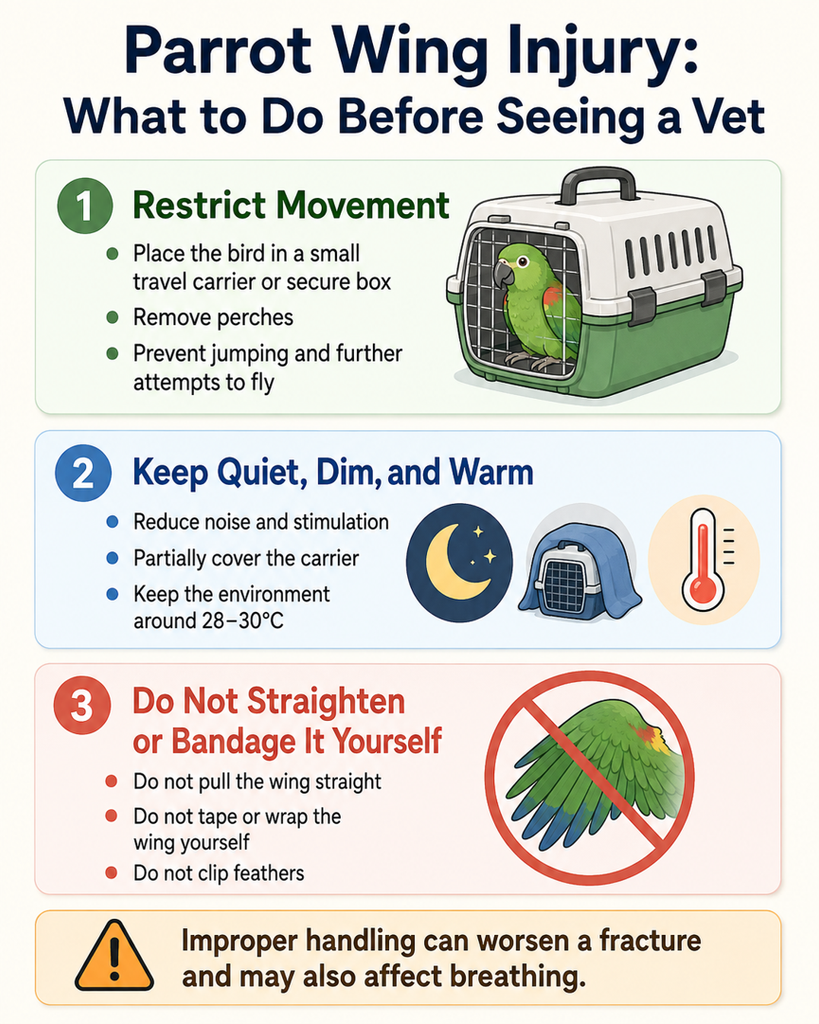
- Do not bandage or pull the wing yourself: Improper bandaging can compress a parrot’s air sacs and cause breathing difficulty, or turn a closed fracture into an open fracture.
- Restrict activity in a small space: Move the parrot to a small carrier or a towel-lined box. Remove perches to prevent jumping or attempts to fly.
- Keep the bird in a dark, warm environment: Cover the carrier and keep it warm, around 28-30°C, to reduce the risk of shock and help the bird feel safe.
Frequently Asked Questions (FAQ)
Q: My parrot’s wing is drooping. Can I observe for a few days to see whether it improves?
A: No. Birds have very fast metabolism, and fractures can begin healing incorrectly within 3 to 5 days. Delayed veterinary care may lead to permanent loss of flight ability or disability.
Q: Should I cut away the feathers before taking an injured parrot to the vet?
A: Let the veterinarian handle this. The veterinarian may trim feathers locally if needed to inspect the wound or perform surgery. Owners should not cut feathers themselves, as this may cause serious bleeding.
Q: How long does it take for a parrot fracture to recover after bandaging?
A: Bird bones heal relatively quickly. Bandage fixation usually lasts about 3 to 6 weeks, with regular follow-up X-rays to monitor bone healing.
Q: Can a parrot fly again after a wing injury?
A: This depends on the injury site, whether the joint is involved, and whether correct treatment is given promptly. With timely and appropriate orthopedic stabilization, many parrots can regain flight ability.
Q: How can I prevent my parrot from crashing during indoor flight?
A: Before free flight, close doors and windows, draw curtains to prevent collisions with transparent glass, switch off running fans, and supervise at all times.
CityVet Avian Consultation
CityVet is committed to delivering excellent, comprehensive veterinary medical services. Guided by the core values of professionalism, care and trust, we provide reasonable fees, introduce advanced equipment, and explain treatment options clearly to pet owners, offering comprehensive medical care for every pet. Want to book a parrot consultation? Please call our Tsuen Wan clinic at 2623 5500 or our Yuen Long clinic at 2477 9990. Address: G/F, 186 Sha Tsui Road, Tsuen Wan / Shop 2, G/F, Fook Shun House, 25 Ping Wui Street, Yuen Long.
Disclaimer: This article provides general information only and cannot replace professional medical diagnosis. If you have any concerns, please book a veterinary consultation as soon as possible.